The most successful lighting in a luxury interior is often the least noticed. Horton Lees Brogden Lighting Design, a professional lighting design practice, puts it plainly: the best interior lighting "often goes unnoticed," not because it lacks impact, but because it feels naturally integrated into the experience of a space. For a minimalist, high-end residence, that means the choice is not between ornate chandeliers and bare bulbs. It is between two families of solutions: light built invisibly into the architecture, and deliberately restrained fixtures that read as quiet sculpture. This guide explains the principles behind both and how to choose between them.
The Essence of Minimalist Luxury Lighting
Minimalist lighting in a luxury context is defined by restraint. The manufacturer Prolicht describes the philosophy as "less is more," where minimalism "does not mean doing without, but conscious choice." The goal is to stage rooms subtly and effectively, drawing attention to what matters without the light source taking center stage. In a luxury interior, this translates to fixtures with clean lines and high-quality materials that balance form and function while preserving the calm of the space.
What distinguishes the luxury application from ordinary minimalism is materiality and integration. A slim pendant or a flush ceiling fixture that gives off a warm glow without taking up visual space becomes, as the lighting retailer White Teak describes it, "part of the architecture itself." The light is felt rather than seen, and the room's expensive surfaces, textures, and proportions carry the visual weight.
Core Principles of Minimalist Lighting Design
Three principles govern the approach. First, less is more: fixtures are chosen deliberately, and each one must justify its presence. TCP Lighting, a lamp manufacturer, frames this as well-placed fixtures that highlight key elements without overwhelming the space.
Second, negative space is treated as a design material. TCP's guidance notes that embracing negative space lets a room breathe and highlights key architectural features; the intentional interplay of light and shadow builds depth and texture rather than filling every corner with brightness.
Third, architectural integration: light works best when considered alongside the architecture from the beginning, as Horton Lees Brogden emphasizes, rather than added after the furniture arrives. Interior designer Natalia Neverko makes the same point for luxury homes: lighting is not the final accessory selected once the furniture is in.
Integrated Architectural Lighting: The Unseen Glow
Integrated solutions hide the source and reveal only the effect. Recessed ceiling fixtures, linear lighting, and concealed strips deliver light without visual intrusion, and modular track systems can be configured to follow straight lines, curves, or complex geometries so the hardware adapts to the architecture rather than fighting it. Prolicht describes its systems this way: luminaires that integrate into any environment, offering everything from spot accent lighting to complete room illumination.
The payoff is atmosphere. Prolicht's stated aim is lighting that "creates an atmosphere that radiates calm and at the same time emphasizes the architectural features of a room." For ambient light specifically, Sculptform, an architectural products company, recommends balancing multiple sources for even, comfortable illumination, and notes that natural light from large windows, skylights, or glass walls can carry much of the ambient load during the day, reducing reliance on fixtures at all.
Minimalist Fixtures: Sculptural Simplicity
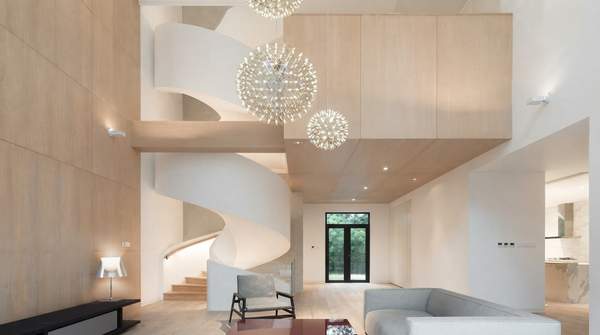
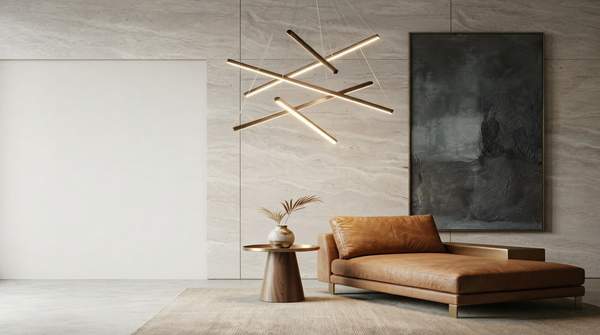
Not everything should disappear. A minimalist scheme can include intentionally visible fixtures, provided they are restrained. White Teak's examples include a single glass globe pendant suspended by a thin rod, which creates balance without clutter, and a floor lamp with a slender base and discreet shade that adds light where needed without dominating the room.
TCP's styling guidance is similarly specific: a tall, slender floor lamp can illuminate a seating area without taking up space, a well-positioned lamp can support focused work in a home office while preventing clutter, and a chandelier with clean lines and minimal ornamentation can anchor a dining table. The test for any visible fixture is whether it earns its place as a quiet sculptural object, echoing the geometric clarity of the interior, or whether it is merely decoration.
Minimalist Luxury Lighting Decision Framework
The framework below classifies each minimalist technique by its primary function and its visual impact, so you can decide whether a goal is best served by concealment or by a visible, sculptural element.
| Lighting Goal | Integrated Approach | Visible Minimalist Fixture | Typical Techniques |
|---|---|---|---|
| Ambient glow | Preferred: recessed ceiling fixtures, concealed linear lighting, natural light from windows and skylights | Possible: flush ceiling fixture with a warm glow | Layered ceiling fixtures, wall sconces, floor lamps; maximize daylight |
| Task focus | Preferred: under-cabinet linear strips, integrated work-surface lighting | Slender floor lamp beside a reading chair or desk | Well-positioned floor lamp; slim pendant over a dining table |
| Accent / architectural highlighting | Preferred: concealed spot accent lighting, track systems following the architecture | Sculptural pendant as focal point | Spot accent lighting with individual luminaires; minimalist track systems |
The reasoning is straightforward: ambient and accent goals reward concealment, because the effect, not the object, is the point. Task lighting tolerates visibility, since a slender lamp near the activity is functional and unobtrusive. A visible fixture is justified when the room needs a focal point that the architecture itself does not provide.
Achieving Ambiance, Task Focus, and Accent
In practice, the layers work together. Neverko describes how integrating multiple light sources lets a single luxury room support breakfast, focused work, entertaining, reading, and quiet relaxation without losing its architectural identity. Sculptform recommends layering ceiling fixtures, wall sconces, and floor lamps into a balanced, inviting glow rather than relying on a single source.
A workable sequence for a luxury living space: establish ambient light through recessed and concealed sources plus daylight; add task light only where activities demand it, using the slenderest fixture that does the job; and finish with accent light on the materials and details that justify the room's luxury, using concealed spots or a track system that follows the architecture. Each layer should be dimmable and independently controlled where possible, so the same room can shift from work to entertaining to quiet relaxation.
Creating Your Serene, Illuminated Space
The decision: implement minimalist lighting by prioritizing integration and subtle effects over ornate fixtures, carefully layering ambient, task, and accent lighting to enhance both functionality and aesthetics. The measurable indicator of success is that the space feels balanced, sophisticated, and uncluttered, with light sources enhancing the architecture rather than dominating it. If a fixture draws attention to itself rather than to the room, it has failed the minimalist test; if the light seems to come from the architecture itself, the scheme is working.
Sources
- Interior Architectural Lighting Design — Horton Lees Brogden Lighting Design
- prolicht-production
- Whiteteak
- Modern Minimalist Lighting Design Ideas for Your Home — TCP Lighting
- Layered Lighting in Luxury Residential Interior Design — Natalia Neverko Design
- Ambient, Task and Accent Lighting Guide — Sculptform