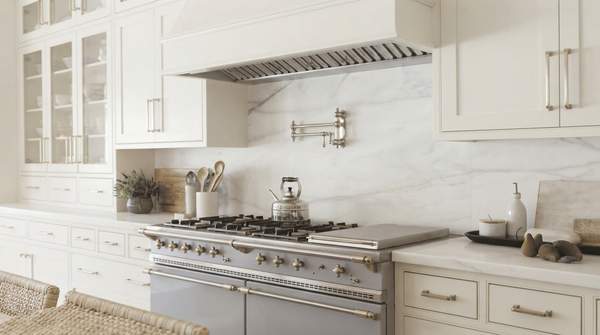
Yes, you can mix metal finishes in a single room—and done deliberately, it makes a space feel layered and professionally curated rather than chaotic. Designers consistently point to the same underlying system: pick one dominant metal, add one or two contrasting finishes in decreasing proportions, and cap the total at three. The framework below turns that consensus into a repeatable process you can apply to any room.
Your Three-Step Framework for Mixing Metal Finishes
Before choosing anything, sort your candidate finishes along two axes: tone (warm, cool, or neutral) and texture (polished, brushed, matte). Then apply a hierarchy. The proportions below are guidelines from design guidance sources, not hard rules—distribution across the room matters as much as the numbers.
| Metal Role | Proportion | Purpose | Key Characteristic |
|---|---|---|---|
| Dominant metal | 60–70% of metal elements | Anchors the design and sets the room's tone | Chosen first; used for larger fixtures and furniture |
| Secondary metal | 20–30% of metal elements | Complements the dominant finish and adds visual interest | Chosen to create contrast with the dominant metal |
| Accent metal | 5–10% of metal elements | Adds depth and character | Used sparingly as a final layer of visual intrigue |
| Overall principle | Two or three metals maximum per area | Prevents visual clutter | Intentional contrast—warm with cool, matte with polished—so each finish stands on its own without feeling mismatched |
One caution on the numbers: sources differ on exact ratios. One design resource recommends an 80/20 split between the dominant metal and everything else; another suggests a 50/30/20 distribution when three metals are used. Treat the 60–70/20–30/5–10 split as a workable middle, and remember that in smaller spaces or if you're less confident, two metals are the safer starting point.
Step 1: Choose Your Dominant Metal (60-70%)
Your dominant metal is the foundation, and it should be chosen first because it sets the overall tone for everything else. Design guidance suggests reserving it for the larger, more visible metal elements—cabinet hardware, light fixtures, appliances—so the room reads as cohesive from the start. Tone is the first filter: metals carry a temperature, running warm, cool, or neutral. Brass and gold sit on the warm side; nickel, chrome, and stainless steel on the cool side. Whichever you pick, commit to it for the majority of the room's metal so the secondary and accent choices have something to push against.