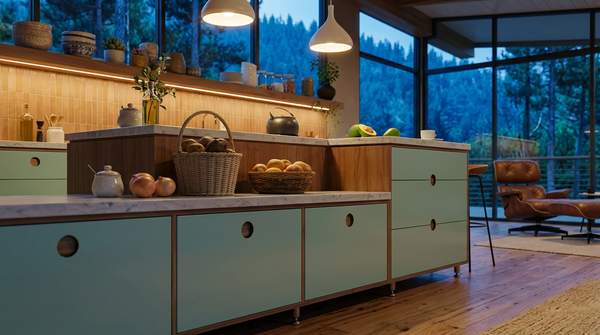
A kitchen can be one of the most visually prominent spaces in a home, especially when the architecture follows the open, connected planning associated with Mid-Century Modern design.
That makes cabinetry more than a storage solution.
Cabinet boxes, doors, wood grain, hardware, proportions, and joinery can all contribute to how the room feels. For homeowners investing in an MCM renovation, understanding the difference between ordinary cabinetry and furniture-grade construction can help make the purchasing decision more informed.
MidModCabs creates premium Mid-Century Modern RTA wood cabinets using ¾-inch cabinet-grade plywood, precision rabbet-and-dado joinery, quality hardware, and proportions developed specifically for MCM kitchens.
Furniture-Grade Starts With the Box
When homeowners look at cabinets, the door is usually the first thing they notice.
But the door is only one component.
The cabinet box provides the structural foundation for the kitchen. It supports shelves, drawers, doors, countertops, and the contents stored inside.
MidModCabs uses ¾-inch cabinet-grade plywood for its cabinet boxes and explicitly positions the system as an alternative to particle-board construction.
That material choice is part of the overall construction philosophy.
A cabinet designed to be part of a long-term kitchen should have a structure appropriate to the demands placed on it.
Joinery Is More Than a Technical Detail
Joinery may not be the first feature that appears on a kitchen shopping list, but it matters.
MidModCabs uses rabbet-and-dado joinery and has developed a proprietary system around traditional joining methods. The components are designed to guide one another into place during assembly.
This approach is particularly relevant to an RTA cabinet system.
The cabinet arrives in pieces, but those pieces still need to come together accurately and form a stable finished cabinet.
For a design-conscious homeowner, the construction method can be as important as the appearance.
Quality Hardware Affects Everyday Use
Cabinet hardware is another area where quality becomes apparent through repeated use.
MidModCabs specifies quality hinges and drawer slides, including soft-close components.
That means the experience of using the kitchen is considered alongside the visual design.
Drawers should operate smoothly. Doors should close with a controlled motion. Hardware should support the cabinet rather than becoming the weak point of the system.
These details may be subtle, but a kitchen is used frequently enough that small differences can become significant over time.
MCM Design Requires Restraint
Furniture-grade construction is only part of what makes a cabinet appropriate for a Mid-Century Modern kitchen.
The design itself needs to understand the style.
MidModCabs emphasizes flat-front doors and authentic MCM proportions, with a cabinet system developed specifically for Mid-Century Modern homes.
That focus matters because MCM design is not simply "old-fashioned modern."
Its visual language relies on clean geometry, balanced proportions, functional design, and an intentional relationship between materials.
A cabinet can be well made and still be the wrong cabinet for an MCM house if its proportions or decorative details feel disconnected from the architecture.
Wood Brings Warmth to the Geometry
Natural wood is a natural fit for many Mid-Century Modern interiors because it balances the clean lines of the architecture with visual warmth.
MidModCabs offers walnut, blonde maple, white oak, and red oak, along with laminate color choices.
That gives homeowners several ways to approach the material palette.
A natural walnut kitchen can emphasize warmth and richness. Lighter woods can create a more open, airy appearance. Colored laminate can provide a stronger visual statement while remaining within the same overall cabinet system.
The choice should ultimately respond to the room.
Three Ways to Approach the Cabinet Front
MidModCabs offers three main handle treatments: ellipse cut-outs, relief cuts, and surface-mounted pulls.
This may seem like a small detail, but hardware can influence the entire appearance of a cabinet wall.
Integrated handles can preserve a particularly clean visual field. Relief cuts create a subtle architectural detail. Surface-mounted pulls introduce an additional material and can become part of the kitchen's decorative language.
The system allows homeowners to make that decision without abandoning the underlying MCM proportions.
Designed as a System
One of the advantages of a system-based approach is consistency.
Instead of treating each cabinet as a separate product, MidModCabs develops its components around a common architectural language. The same system can accommodate different room sizes, storage requirements, materials, and finishes.
That makes it easier to create a kitchen that feels cohesive.
It also allows the homeowner to choose the configuration based on the room rather than selecting a completely different cabinet line for every part of the kitchen.
Furniture-Grade Does Not Have to Mean Fully Custom
The traditional perception of premium cabinetry is often tied to a fully custom shop.
MidModCabs takes another route.
Its cabinetry is designed as a premium system but delivered in an RTA format. The company positions the approach as combining custom-shop thinking with flat-pack delivery.
For homeowners, that can provide a different balance between design, construction, logistics, and investment.
The key is that the cabinet system is still planned around the actual room.
The Design Process Makes the Difference
MidModCabs does not treat ordering as simply selecting cabinet boxes from a list.
The formal design process begins with measurements, ceiling height, windows, doors, appliance locations, and photographs. The team then develops the layout and works through cabinet placement, finishes, wood direction, color, storage, and other project details.
Visualizations are also created to help clients understand the proposed design before production.
For an MCM renovation, that process can be especially useful because proportion and relationship to the surrounding architecture matter so much.
Built for the Kitchen You Are Actually Planning
Furniture-grade cabinetry should ultimately be evaluated in the context of the project.
What is the room size? What appliances are being used? How much storage is necessary? Does the kitchen include an island? Are there unusual wall conditions? Which original architectural elements need to remain visible?
MidModCabs offers 12-, 16-, and 20-foot kitchen packages as starting points, while additional cabinet types and configurations can be incorporated as the design develops.
That combination of defined starting points and project-specific planning gives homeowners a practical way to begin.
If you are planning a Mid-Century Modern kitchen and want cabinetry that treats construction and design as equally important, start with your room measurements and inspiration. MidModCabs can help determine the appropriate configuration and develop the project from there.