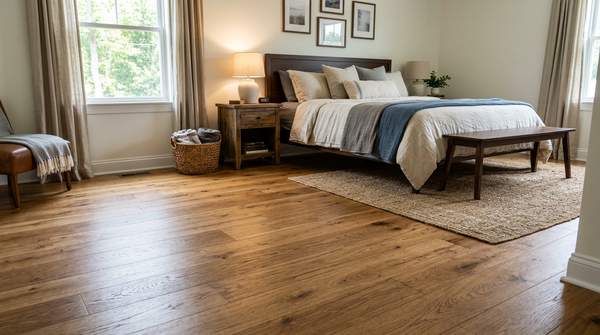
A new artificial intelligence system can now analyze a photograph of a room and identify its interior design style—from Art Deco to Scandinavian—with an accuracy that substantially outperforms existing models. Developed by computer scientists, this AI moves beyond simply recognizing prominent objects like sofas and tables. Instead, it has been engineered to perceive the subtle visual cues that truly define an aesthetic, such as the specific grain of wood, the texture of fabric weaves, and the harmony of a color palette. This approach allows the model to interpret a space in a way that more closely resembles human judgment.
The system, called the Style-Aware Attention Transformer (SAT³), was created by researchers at RMIT Vietnam and RMIT Melbourne. Their work, detailed in a study published in Discover Artificial Intelligence, addresses a problem that is deceptively complex for machines. While a person can often distinguish a minimalist interior from a bohemian one, the differences frequently lie in fine details and the overall atmosphere rather than the presence of specific items. SAT³ represents a significant advance in teaching AI to comprehend this nuanced visual language, achieving 83.7% accuracy in its classifications.
The Subtle Art of Style: A Challenge for AI
Identifying fine-grained interior design styles is a uniquely difficult task for artificial intelligence because the defining characteristics are often subtle and dependent on context. The researchers behind SAT³ note that these stylistic cues are frequently "entangled with dominant semantic objects." In other words, the very elements that signal a specific style—a particular type of ornamentation, a material finish, or a color relationship—are not standalone features but are integrated into the larger objects that occupy a room. A traditional AI model might correctly identify a chair, but it would likely miss that the chair's bentwood frame and caned seat are hallmarks of a mid-century modern aesthetic.
Previous technologies have struggled with this distinction. Convolutional neural networks (CNNs), a common type of AI for image analysis, are effective at capturing local patterns like textures but often lack the ability to perform the global reasoning needed to understand a room's cohesive style. On the other hand, standard Vision Transformers, a more recent architecture, can model the spatial relationships between objects but are not explicitly designed to encode the perceptual attributes of style. This creates a gap where an AI can see the objects in a room but cannot interpret the aesthetic they collectively create. For interior design, where subtle cues like material texture and decorative patterns are often more important than the identity of an object, a more specialized approach is required.
The Transformer's Gaze: Understanding the Attention Mechanism
The SAT³ model is built upon a powerful AI architecture known as a transformer. Originally developed for processing sequential data like language, transformers have proven highly effective in other fields, including computer vision. Their core innovation is a process called the "attention mechanism," which allows the model to weigh the importance of different parts of its input data when making a prediction. For text, this means understanding which words in a sentence are most relevant to each other. For images, which are converted into a sequence of patches, it means determining which parts of the picture are most critical for a given task.
This mechanism works by calculating "attention scores" for different parts of the input. In simplified terms, the model creates three vectors for each piece of data: a Query (Q), a Key (K), and a Value (V). The Query represents the current piece of data being focused on, the Key represents all other pieces of data, and the Value contains the actual information of those pieces. By comparing the Query to each Key, the model determines how much attention to pay to every other part of the input, and then uses those scores to create a weighted sum of the Values. Many models use a "multi-head" approach, running this process in parallel multiple times to capture different types of relationships simultaneously, enhancing the model's ability to learn diverse features.
Deconstructing SAT³: How AI Recognizes Interior Design Styles
The key innovation of SAT³ is its "style-aware" attention, which adapts the general transformer architecture to the specific challenge of recognizing aesthetics. Instead of allowing the attention mechanism to focus on the most obvious objects, the model is engineered to prioritize the subtle, distributed cues that define a style. It learns to assign higher attention scores to the visual information contained in textures, color palettes, and decorative motifs, effectively seeing past the sofa to analyze the weave of its fabric.
This specialized focus yields a significant improvement in performance. In tests, SAT³ achieved an accuracy of 83.7%, a gain of 6.8 percentage points over the strongest baseline model, a standard Vision Transformer which reached 76.9% accuracy. The following framework breaks down the difference in how these systems analyze an interior space.
| Aspect | Traditional Image Recognition | SAT³ Style-Aware Recognition |
|---|---|---|
| Core Challenge | Struggles to identify subtle, context-dependent stylistic cues that are intertwined with prominent objects in a room. | Specifically designed to overcome the challenge of subtle cues by focusing on the elements that define a style. |
| Analytical Focus | Identifies dominant semantic objects within an image, such as a "sofa," "table," or "lamp." This approach often overlooks the nuanced details that define a design style. | Discerns subtle stylistic cues like material textures, decorative patterns, color palettes, and the warmth of wood. This allows the model to "see" beyond objects to the underlying aesthetic. |
| Underlying Mechanism | Often relies on CNNs that capture local patterns but lack global reasoning, or standard transformers that model spatial relationships without encoding style. | Uses a transformer architecture with a specialized "style-aware attention" mechanism that learns to prioritize style-specific visual information. |
| Performance Outcome | Achieves lower accuracy in fine-grained style classification. The strongest baseline model in comparative tests reached 76.9% accuracy. | Achieves high accuracy in recognizing interior design styles. The model reached 83.7% accuracy, a nearly 7-point improvement over the best baseline. |
From Lab to Living Room: Potential Applications in Design
The ability of an AI like SAT³ to accurately classify nuanced interior design styles opens up a range of practical applications for professionals and enthusiasts. This technology could power tools that go far beyond simple keyword searches, offering a more intuitive way to interact with visual information. For interior designers, it could be used to automatically tag vast libraries of images with detailed style information, making it easier to find specific visual inspiration for mood boards and client presentations.
For retailers, this technology could drive more sophisticated recommendation engines. Instead of suggesting products based on broad categories, an e-commerce site could analyze a user's inspiration images and recommend furniture and decor that genuinely match their preferred aesthetic, down to the material finishes and color harmonies. Furthermore, such a system could serve as an educational tool for design students, helping them deconstruct images and identify the specific textures, patterns, and forms that characterize different historical and contemporary styles. The researchers behind SAT³ note that while many AI models improve general visual discrimination, they are not specifically designed for interior style, where subtle cues are often more important than the identity of a dominant object. This specialized focus is what gives the technology its potential to become a valuable assistant in creative and commercial design processes.
The Future of AI in Interior Design: A Style-Aware Assistant
Interior designers and enthusiasts can anticipate AI tools, leveraging models like SAT³, that offer sophisticated style analysis and personalized recommendations, moving beyond basic object recognition. This development points toward a future where digital assistants can understand and articulate the principles of design with greater nuance, acting as collaborators in the creative process. By learning to see style in a more human-like way, AI is poised to become a more intuitive and powerful tool for anyone working with interior spaces.
A key development to watch for is the emergence of commercial AI platforms or software tools that explicitly advertise 'style-aware' or 'fine-grained aesthetic recognition' capabilities for interior design, particularly those citing research on transformer models.
Sources
- A style aware attention transformer for fine grained interior design style recognition — SpringerLink
- What Is a Transformer Model? — NVIDIA Blog
- What is a Transformer Model? — IBM
- What are Transformers? - Transformers in Artificial Intelligence Explained - AWS — Amazon Web Services, Inc.
- New AI Transformer Learns to See Interior Design Styles the Way Humans Do — BIOENGINEER.ORG