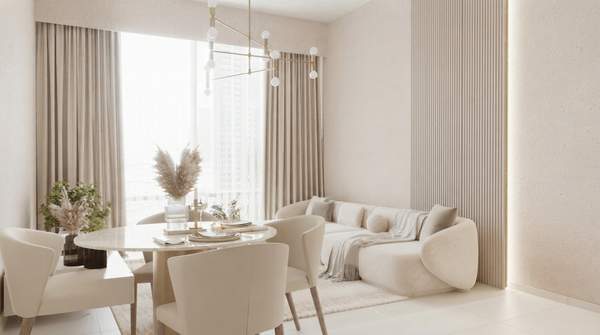
Quiet luxury is a design philosophy built on three tenets: what things are made of, how well they are made, and how deliberately they are chosen. Design writers consistently describe it as an approach that prioritizes substance over spectacle—natural materials, exceptional craftsmanship, and intentional selection over conspicuous branding or fleeting trends. Crucially, it is not minimalism. Where minimalism empties a room, quiet luxury edits it, keeping many objects but none that arrive by accident. Understanding that distinction, and applying a simple "remove and test" method to every purchase, is what turns the aesthetic from a buzzword into a durable way of designing a home.
Understanding Quiet Luxury: Beyond the Buzzword
Across design publications and studios, the definition converges on the same core. The Oblist's guide frames it as "a philosophy to embrace—one that prioritizes substance over spectacle, craftsmanship over conspicuous consumption," achieved through curated materials, restrained palettes, and purposeful spatial arrangements. The mastery, that guide argues, lies in "the deliberate editing: knowing what to include and, perhaps more importantly, what to leave out."
Material quality comes first. As Tedi Bezna of THELIFESTYLEDCO puts it, "In a quiet luxury interior, what something is made of matters more than what it looks like at first glance." Solid wood frames, natural stone, hand-woven textiles, and top-grain leather hold up physically and visually over time; they develop character, while fast furniture does not. Native Trails' design writer Julianna Cementina extends the same logic to organic materials such as concrete, copper, marble, and reclaimed wood, which "bring authenticity and depth to a space, growing more beautiful over time."
Craftsmanship is the second pillar. King Living's design guidance describes every detail in a quiet luxury room as "a testament to exceptional craftsmanship and the integrity of the design," where even lighting and side tables contribute to a relaxed, curated atmosphere. The third pillar is intentionality: a mix of old and new, industrial and organic, blended so it feels "intentional yet effortless," in Cementina's words—refined but also enduring, and built for real living rather than display.
Quiet Luxury vs. Minimalism: A Crucial Distinction
The most common misunderstanding is that quiet luxury simply means owning less. House of Nuances, a Berlin design studio, draws the line precisely: "Minimalism is a formal design discipline defined by reduction and the active use of negative space. Quiet luxury prioritises depth of material and intentionality of selection—a quiet luxury room can contain many objects, but none that are there by accident. The distinction is editing, not emptying."
That difference shows up in three practical ways. First, objects: minimalism removes them to achieve simplicity, while quiet luxury keeps pieces that earn their place through material and form. Second, materials: a minimalist room can feel stark because reduction is the goal; a quiet luxury room layers plush textiles, warm neutrals, and polished materials—LUXE Interiors + Design describes the style as focusing "on comfort in a classy and effortless way, highlighting quality pieces that make a sophisticated statement." Third, space: negative space in minimalism is an active design element, whereas in quiet luxury, space is simply what remains after thoughtful curation. A quiet luxury room can even carry a single strong material pattern, according to House of Nuances—what it excludes is competing patterns or pattern used to fill visual space "that has not been earned."
The Quiet Luxury Decision Framework: Making Intentional Choices
The philosophy becomes usable when reduced to a test you can apply to any candidate purchase. House of Nuances states it plainly: "remove one element and ask whether the space is poorer for it. If not, it did not belong." That remove-and-test principle distinguishes an object whose contribution comes from intrinsic quality—material, form, craftsmanship—from one resting on ornament, trendiness, or brand recognition. The matrix below applies that test across the three decision points that shape any room.
| Decision point | Ask this question | Aligns with quiet luxury if… | Remove-and-test result |
|---|---|---|---|
| Material choice | What is it made of, and how will it age? | Solid wood, natural stone, hand-woven textiles, top-grain leather, concrete, copper, marble, reclaimed wood—materials that develop character over time | Removing it leaves the room tactilely and visually poorer; a substitute in imitation material would be noticeable |
| Anchor furnishing | Is this the largest piece in the room, and is it the best-made thing in it? | Investment concentrates here—the sofa, bed, or dining table sets the standard for everything that follows, and it need not be unusual in form | The room's standard drops without it; proportion and quality, not statement, carry the space |
| Decorative object | Does its value come from craftsmanship and design integrity, or from trend and brand? | It is a "conversation piece" through quality—clutter-free, balancing the room's colors and light | Its absence leaves a gap in the composition; if nothing is lost, it did not belong |
Two rules govern the framework. The anchor-piece investment rule, from Bezna's guidance, holds that every room has one piece that sets the standard—the sofa in a living room, the bed in a primary suite, the dining table in a dining space—and that is where investment matters most. The curation rule, from House of Nuances, holds that quality over novelty, proportion over statement, and material integrity over surface decoration apply across the entire approach. A piece can pass one test and fail the other; a well-made sofa in a garish trend color is not quiet luxury, and neither is a neutral room furnished in fast furniture.
Applying Quiet Luxury: Living Room and Bathroom
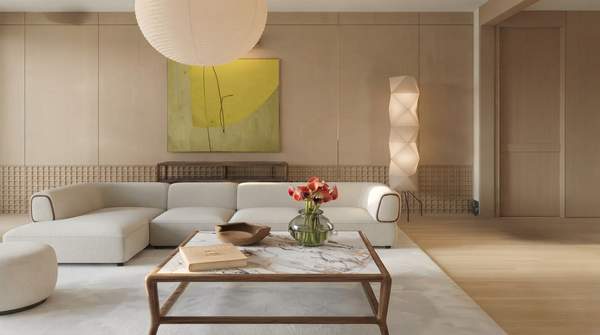
In the living room, House of Nuances recommends building around "one generous seating group rather than several small ones," letting texture, proportion, and light do the work. Hommés Studio's examples follow the same logic: soft-hued chairs, tables, and suspended lamps in pink, beige, or grey create "an ambiance of simple luxury," while a dining arrangement in pristine white leather and rich black silk shows how a few tactile materials produce enduring elegance. A contemporary rug can introduce texture against an elegant wallcovering, with notable artworks punctuating rather than crowding the space.
The bathroom demonstrates the philosophy most compactly. Here, according to House of Nuances, "the luxury lies in thickness and proportion—a basin carved from a single block, a stone threshold with real depth—rather than in the number of features." A smooth marble counter and well-proportioned fixtures matter more than added gadgets; the overall effect should feel effortlessly curated and refined. Native Trails points to concrete sinks and tubs as an example of organic materials bringing authenticity to the bath, aging gracefully rather than dating themselves.
Achieving Enduring Elegance: Your Next Steps
Prioritize intrinsic quality and intentional curation in all design choices, focusing on material integrity, craftsmanship, and thoughtful editing over fleeting trends or conspicuous display. Practically, that means starting with the anchor piece in each room, choosing materials that improve with age, and subjecting every remaining candidate to the remove-and-test question before it enters the space.
The measurable indicator of success is a space that feels effortlessly sophisticated, comfortable, and deeply personal, where every element contributes to a cohesive and enduring aesthetic. That is observable: walk through the room and remove one element in your mind. If the space is poorer for its absence, it has earned its place. If not, it did not belong—and the room is better edited without it.
Sources
- Quiet Luxury Interior Design: What It Really Means in 2026 — House of Nuances
- What Is Quiet Luxury Interior Design? Guide — The Oblist
- Quiet Luxury Interior Design: What It Really Means — THELIFESTYLEDCO Shop
- Quiet Luxury and the 4 Design Ethos that Define it — Nativetrailshome
- How to achieve a quiet luxury aesthetic — Kingliving
- 17 Quiet Luxury Interior Designs For A Sophisticated Outlook — LUXE Interiors + Design