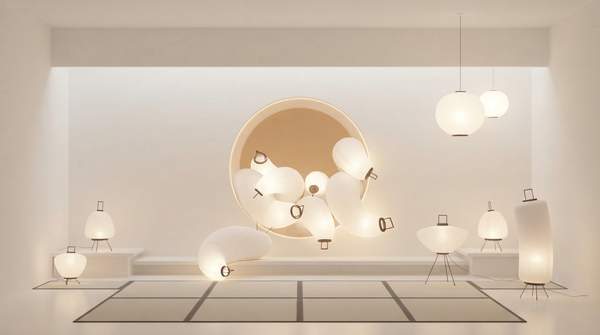
Isamu Noguchi's Akari lanterns are considered masterpieces of modern design because they are a deliberate synthesis: a centuries-old Japanese lantern craft from Gifu, reworked by a modernist sculptor who substituted an electric bulb for the candle, gave the lantern a collapsible form, and framed the result not as lighting but as sculpture. The name itself carries the idea. "Akari" is a Japanese word meaning "light," with associations of both illumination and weightlessness, according to The Noguchi Museum's account of the series.
Isamu Noguchi's Akari: A Fusion of Tradition and Modernity
The story begins in spring 1951, when Noguchi stopped in Gifu while traveling to Hiroshima to work on a memorial cenotaph for Kenzo Tange's Peace Memorial Park. Gifu had been a center of chochin—collapsible paper lantern—manufacture for centuries, but the postwar economy had hammered the industry. The city's mayor appealed to Noguchi to help revitalize the craft and offered him a commission. Noguchi created two lantern ideas the following day; a short article in the local newspaper described the prototypes as "deformed."
That unpromising reception aside, the encounter produced one of the most recognizable objects in modern interiors. Noguchi's works, as the Millennium Gallery JP journal notes, blend traditional Japanese craftsmanship with Western modern design, and the Akari lamp became a symbol of that fusion—conveying, in its makers' telling, the beauty and warmth of Japanese culture through light.
The Gifu Chochin: A Legacy of Light
The traditional craft Noguchi encountered was built on two humble materials: paper and bamboo. Gifu's chochin lanterns had hung for generations along the Nagara River area, and Noguchi saw them in their working context during his visit. He met with the Ozeki family at their workshop, the same lineage of makers whose company, Ozeki & Co., still produces Akari today.
The craft itself is demanding. Akari shades are handmade from mulberry bark washi paper and bamboo. This was the inherited vocabulary of Gifu lantern-making—supple bamboo strips arranged as ribbing, paper stretched over them, a form that could collapse and expand.
Noguchi's Modernist Intervention: Transforming a Craft
Noguchi's changes were surgical rather than wholesale. He kept the materials and the makers, but he substituted an incandescent lightbulb for the traditional candle—a move The Noguchi Museum describes as instantly making the lanterns modern. He also designed Akari to be collapsible for flat-pack shipping: after the shade dries in a specially heated room, the mold is collapsed and removed from the inside, and the shade folds flat for efficient packaging and distribution.
That logistical innovation mattered as much as the aesthetic one. A collapsible, shippable paper lamp could reach homes, offices, hotels and restaurants far beyond Gifu, and it placed the series among the longest-running design objects of the modern era—comparable, as one design guide observes, to Marianne Brandt's Bauhaus HMB pendant lamp, which preceded it by two decades and remains in production.
The Philosophy of 'Akari': Light as Sculpture
What elevates Akari beyond a successful industrial design is Noguchi's insistence on treating them as sculpture. The Noguchi Museum's shop description frames the series as dissolving "the boundary between function and art," moving, in its words, "from Noguchi's mind, to craftspeople' hands, and, finally, in people's homes."
Noguchi's own statements make the ambition explicit. Assessing the series near the end of his career, he wrote, "They seem to offer a magical unfolding away from the material world." He was fond of saying, "All that you require to start a home are a room, a tatami, and Akari." The word he chose for the series—light, with its connotation of weightlessness—was the philosophy compressed into a name.
Essential Materials: Washi Paper and Bamboo Ribbing
The Akari aesthetic is not separable from its materials. The characteristic construction is washi paper over bamboo ribbing, and the quality of the light follows directly from the mulberry-bark paper. Matthew Kirsch, curator and director of research for The Noguchi Museum, told Wallpaper* that "there is an obvious beauty to the way light suffuses and filters through the mulberry bark paper used for Akari that probably accounts for a good bit of their lasting appeal," adding that "there is a warmth in the way light is transmitted through the paper of an Akari that is missing from its many imitators."
The bamboo does structural work that is also poetic. The delicacy of the washi paper and the suppleness of the bamboo strips create what Millennium Gallery JP calls a poetic presence: the soft light emitted by the paper envelops a space like moonlight, reflecting gently off walls and floors, with even the shadows functioning as design elements.
The Akari Design Deconstructed: Tradition Meets Modernism
To see exactly how the synthesis works, it helps to trace each feature of an Akari lantern back to its origin—either in the inherited Gifu craft or in Noguchi's modernist intervention—and then to the resulting "Akari" principle that their combination produces.
| Design feature | Origin | How it works in the finished object |
|---|---|---|
| Washi paper shade, bamboo ribbing | Traditional Gifu chochin craft | Handmade mulberry-bark paper over supple bamboo strips diffuses light into a warm, soft glow |
| Incandescent lightbulb | Noguchi's modernist intervention (1951) | Replaced the traditional candle, instantly making the lantern a modern object |
| Collapsible, flat-packing form | Noguchi's modernist intervention | The mold is collapsed and removed from inside; the shade folds flat for shipping worldwide |
| Sculptural framing of light | Noguchi's philosophy of "light as sculpture" | The lamp is presented as a luminous object dissolving the boundary between function and art |
| The name "Akari" | Noguchi's chosen term | A Japanese word meaning "light," with associations of illumination and weightlessness |
Read down the first column and the pattern is clear: the materials are inherited, the technology and logistics are modern, and the framing is sculptural. No single element is unprecedented; the mastery lies in Noguchi's attribution of each feature to the tradition or the intervention that best served it, so that the warm, weightless quality of the light emerges from the fusion itself.
Akari's Enduring Appeal in Modern Design
Seventy-five years on, Akari light sculptures have, in Wallpaper*'s phrase, "nearly become as universal as light itself," glowing in homes, offices, hotels, restaurants and film and TV sets. The Noguchi Museum marks the anniversary with the exhibition "No Ordinary Light: Akari at 75," on view through September 5, 2027. The design's persistence in contemporary interiors is, on the evidence, no accident: a form that preserves tradition while blending into modern living spaces bridges Japanese and Western aesthetics, which is precisely why it reads as at home in both a tatami room and a minimalist loft.
Akari's Enduring Legacy: A Masterpiece of Light and Form
The conclusion for any reader assessing Akari's place in design history is to recognize the light sculptures as a deliberate synthesis of traditional Japanese craft and modernist sculptural principles, embodying a unique philosophy of light and weightlessness. The materials came from Gifu's chochin tradition; the bulb, the collapsible form and the sculptural ambition came from Noguchi; the name declared the intent. The measurable indicator of that synthesis's success is visible today: the continued global appreciation and exhibition of Akari light sculptures by institutions like The Noguchi Museum—including the 75th-anniversary exhibition running through September 5, 2027—and their persistent presence in contemporary design discourse.
Sources
- History of Akari Light Sculptures - The Noguchi Museum
- Isamu Noguchi Akari Lamps: History, Design & Gifu Lanterns — Millennium Gallery JP
- A Complete Guide to Isamu Noguchi's Akari Lamps - Sixtysix
- Akari Light Sculptures — The Noguchi Museum
- How Isamu Noguchi's Akari lantern became a design classic — Wallpaper*