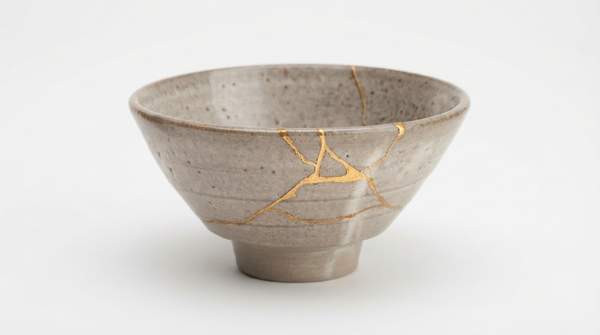
Kintsugi, the Japanese art of mending broken pottery with urushi lacquer dusted in gold, has outgrown the tea room. Its central proposition, that damage should be displayed with dignity rather than disguised or discarded, is now being taken up by product designers, architects, and post-disaster recovery programs as a working counter-philosophy to a culture of replacement. The repaired bowl is not a compromised object; it is, as one account of the tradition puts it, "a quiet manifesto," transformed by its history rather than diminished by it.
Introduction: Kintsugi – The Art of Golden Repair
The practice emerged in Japan during the Azuchi-Momoyama period in the late 16th century, when the tea ceremony was flourishing and tea bowls valued for their natural textures and asymmetry were considered too precious to throw away when they broke. Repairing them with seams of gold was not a workaround but an elevation: the crack became part of the object's identity. Kintsugi embodies wabi-sabi, the aesthetic reverence for imperfection and impermanence, and its logic runs directly against the instinct to restore an object to a flawless "like-new" state. The repair is meant to be seen.
What has changed in recent years is the scope. As the cultural travel platform Deeper Japan observes, kintsugi has become "a metaphor and method across disciplines," serving as a source of emotional healing, a model for sustainable design, and a muse for digital and conceptual art. The craft's migration from pottery into product design, interiors, and community recovery is what makes it a contemporary ideology rather than a historical curiosity.
The Kintsugi Ethos: From Broken Pottery to Modern Manifesto
To see how a pottery technique scales into a worldview, it helps to separate the philosophy into its component principles and then trace where each one surfaces today. Three tenets recur across accounts of the tradition: embracing imperfection in the wabi-sabi sense, valuing an object's history rather than erasing it, and treating breakage as an occasion for resilience and rebirth. The table below maps each principle onto the documented domains where it now appears, from sustainable product design to architectural detailing to community healing after disaster.
| Domain | Principle | What the evidence shows |
|---|---|---|
| Kintsugi philosophy | Embracing imperfection (wabi-sabi) | Kintsugi celebrates visible damage, aligning with wabi-sabi's appreciation of impermanence; flaws are redefined as integral to an object's beauty and narrative rather than as defects to hide. |
| Kintsugi philosophy | Valuing an object's history | The golden repair highlights an object's journey, marking its continuity and evolution over time instead of erasing the evidence of damage. |
| Kintsugi philosophy | Resilience and rebirth | The repaired vessel symbolizes strength and renewal after breakage, a metaphor that extends to personal and community healing. |
| Contemporary application | Sustainable product design | Designers reinterpret kintsugi as a metaphor for sustainability, shifting emphasis from discarding to preservation, continuity, and care, and explicitly critiquing overconsumption. |
| Contemporary application | Architectural and interior details | Brass inlays marking cracks in marble, deliberate joins in timber, and the embrace of asymmetry carry the same sensibility into interiors, treating evidence of time as a measure of authenticity. |
| Contemporary application | Social and community healing | Post-earthquake repair initiatives in Japan have used free kintsugi repairs and kintsugi-based workshops to support emotional recovery and community resilience. |
Read down the first column and the argument becomes visible: the three philosophical tenets are not decorative ideas about pottery but transferable commitments, and each has found a documented foothold in a modern domain. The remainder of this article traces those footholds in detail.
Kintsugi as a Critique of Consumer Culture in Product Design
The sharpest contemporary reading of kintsugi positions it against planned obsolescence. Deeper Japan frames the contrast bluntly: in a world of products deliberately slowed by updates and last season's items cast off after one cycle of use, a kintsugi-repaired plate declares the opposite, that "old isn't broken—it's lived," a philosophy the article calls the antithesis of modern consumer culture. The critique is structural, not sentimental. Mass production depends on the invisibility of an object's history; kintsugi makes that history the most valuable thing about it.
Designers are responding in kind. Some now create products meant to be repaired creatively when they break, building the possibility of visible mending into the object from the start. The designer Xiaodong Ma's project "Repairing Society" critiques overconsumption through a kintsugi lens, treating repair itself as a design brief. The design studio FrescoForma describes the same shift in language that echoes the original craft: in an age of mass production, "the act of repair becomes a quiet form of resistance," and repair can be design rather than a failure of it. The emphasis moves from replacement to preservation, continuity, and care.
Embracing Imperfection in Architectural and Interior Design
In interiors and architecture, kintsugi's influence shows up less as literal gold seams and more as a changed attitude toward surfaces. FrescoForma points to concrete details: a brass inlay marking a crack in marble, or a deliberate join in timber, evoking the same poetic sensibility as the repaired bowl. The intention, the studio argues, is recognition rather than nostalgia, an acknowledgment that "every surface has a memory," and a design language that values evidence of time as a measure of authenticity.
The same source notes that in architecture the idea manifests through adaptive reuse and visible restoration, where history becomes a living layer of form rather than something to be stripped out. Studio Lahav, writing on kintsugi in interior projects, identifies two practical routes for the homeowner: embracing asymmetry and unexpected patterns, or incorporating kintsugi craftsmanship directly into a scheme, with gold lacquer repair reading as an element of opulence as much as of repair. Either way, the flaw stops being a problem to be corrected and becomes a feature to be composed.
Beyond Objects: Kintsugi as a Metaphor for Healing and Resilience
The philosophy's furthest reach is human. Millennium Gallery JP, a Japanese gallery and journal, describes kintsugi as teaching acceptance of imperfection rather than the pursuit of it, a stance the gallery connects to self-acceptance and emotional healing. In Japan, a country that has historically experienced earthquakes and floods, the idea that overcoming hardship leads to becoming "stronger and more beautiful" has taken root culturally, the gallery notes, well beyond the workshop.
That metaphor has been put to organized use. After the major earthquakes of the 2000s, people offered free kintsugi repairs for damaged vessels as a way to heal and encourage others. Following the Kumamoto earthquake, shards from potters whose work had been destroyed were taken in by Wajima-nuri artisans, repaired with techniques including kintsugi, and reborn as vessels hosting "new beauty," with a stated spirit of "Don't let the earthquake defeat us!" The project reached 140 percent of its crowdfunding goal. In Tome City, Miyagi Prefecture, an area affected by the Great East Japan Earthquake of March 2011, international NGOs have run workshops combining kintsugi technique with the concept of Post-Traumatic Growth to aid survivors' emotional recovery. Repair, in these settings, is a community practice.
Embracing Imperfection: Kintsugi as a Path Forward
Readers can apply Kintsugi principles to evaluate design choices, promote sustainable practices, and foster personal and community resilience by recognizing value in repair and imperfection. The decision the tradition offers is concrete: when an object, a room, or a plan is damaged, the options are not limited to concealment or disposal. A visible, dignified repair preserves history, extends an object's life, and in the documented cases above, has even supported collective recovery after disaster.
The measurable indicator of this philosophy taking hold is increased recognition and adoption of visibly repaired or imperfect items in personal spaces and public discourse, alongside a growing emphasis on longevity and emotional connection in design. That shift is already observable in the evidence: designers building repair into products, studios treating worn surfaces as authenticity, and repair initiatives reaching beyond their funding goals. The crack, inlaid with gold, is no longer where the object's value ends; it is where its second life begins.
Sources
- Kintsugi Design: Meaning, Philosophy & Contemporary Uses — FrescoForma.
- Modern Kintsugi – Learn the Beauty and Philosophy of Japanese Lacquer Art in Tokyo — TOKI
- Kintsugi Futures: Repair and Emotional Resilience — Deeper Japan
- Creative Ways to Use Kintsugi Pottery for Interior Design Projects — jac lahav
- Kintsugi Meaning: Embracing Imperfection for Healing — Millennium Gallery JP
- Kintsugi: Healing Hearts & Communities After Disaster — Millennium Gallery JP