Terroir — the sum of environmental conditions and human craft that give a food its sense of place — is not exclusive to wine. In specialty coffee and craft chocolate, the same principle applies: soil type, climate, altitude, and post-harvest processing combine to produce flavor notes you can trace back to a specific origin. Volcanic ash in Central America can give coffee bold chocolate and spice notes; reddish soil in Madagascar can lend chocolate a tart fruitiness; a smoke-drying tradition in Papua New Guinea can put unmistakable smoky tones in the bar. Understanding these connections lets you explain why a coffee or a chocolate tastes the way it does — and choose accordingly.
Introduction: The Essence of Terroir Beyond Wine
The concept of terroir comes to coffee and chocolate directly from the wine world, where a vineyard's location has long been understood to shape a wine's sensory qualities. A scientific review of coffee terroir notes that factors such as air temperature, solar radiation, rainfall, soil water holding capacity, and nitrogen are associated with location and significantly contribute to wine's character — and that in coffee, terroir is most notable in single-origin coffees that represent their growing location.
Coffee roasters describe terroir the same way. Achilles Coffee Roasters defines it as "the distinctive set of environmental conditions that influence how coffee is grown and how it ultimately tastes in the cup" — not a single factor but a combination of climate, soil, altitude, and sunlight exposure working together on the plant and its cherries. Chocolate makers make a parallel case. Writing for Shekoh Confections, Shekoh Moossavi frames chocolate as having "its own sophisticated relationship with terroir, akin to that of its vinous cousin," with climate, soil type, and altitude shaping the palate of the cocoa bean.
What makes the comparison worthwhile is that both products respond to the same categories of influence — environment and processing — yet express them differently. The same volcanic soil that pushes coffee toward bold, spicy notes can push cacao toward an entirely different sensory profile, and processing choices that are routine in one industry create signature flavors in the other.
Environmental Factors: The Earth's Signature on Flavor
Soil is where the flavor journey begins for both crops, and regional examples show how sharply its effects can vary. In coffee, Script Coffee's Kevin Durbin points to Central America, where volcanic ash feeds coffee plants rich nutrients and produces bold flavor profiles full of chocolate and spice, while Kenya's sandy loam is associated with bright coffees carrying hints of blackcurrant and citrus. In chocolate, Shekoh Confections credits Madagascar's unusual reddish soil with the tart fruitiness characteristic of its cocoa, while El Dulce Origen describes how Manabí, Ecuador's cacao is shaped by alluvial-volcanic soils and a distinct coastal microclimate at the transition between tropical wet forests and semi-arid scrublands, influenced by the collision of the cold Humboldt and warm Panama ocean currents.
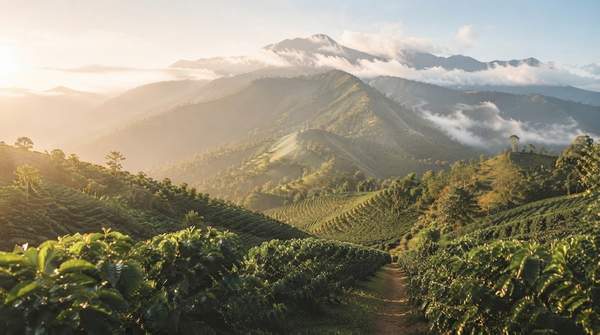
Climate and altitude work on ripening speed and bean development. Achilles Coffee Roasters explains that temperature, rainfall, and seasonality determine how quickly or slowly coffee cherries ripen, with a stable, moderate climate and distinct wet and dry seasons tending to produce more consistent, balanced flavors. Altitude is a particularly visible variable in the cup: high-elevation Ethiopian coffee often reveals jasmine-like florals and bursts of blueberry, while lower-elevation Brazilian coffee leans toward richness, body, and nutty undertones, with medium elevations favoring balance, sweetness, and mild acidity.
For cacao, the International Cocoa Organization's evaluation framework — as summarized by CocoaSupply — treats terroir as one of five key criteria in assessing fine-flavor origins, defined by how climate, soil, altitude, and growing conditions affect the final flavor. That institutional recognition matters: it means terroir is not a marketing flourish but a formal part of how producing countries are judged for flavor quality.
Processing Methods: Human Craft and Distinctive Taste
Environment sets the potential; processing determines how much of it survives into the cup or the bar. In coffee, the choice between washed and natural processing is often dictated by geography itself. Sagebrush Coffee notes that in Ethiopia, where water scarcity is an issue, the natural method is preferred because it requires no water, while regions with abundant water favor the washed process. The flavor consequences are significant: washed coffees tend toward a cleaner, brighter profile with citrus notes, while naturals are more fruit-forward and complex, with honey-processed coffees showing attributes of both.
Some processing methods are so distinctive they define an entire origin. Sumatra's Giling Basah, or wet-hulled, process — combined with the island's high humidity and volcanic soils — produces coffees with low acidity, heavy body, and notes of earth, herbs, and cedar, according to Sky Mountain Coffee, with the Lintong and Mandheling regions particularly famous for this profile.
Chocolate has its own signature example. Shekoh Confections attributes the unique smoky tones of Papua New Guinean chocolate to the region's distinct smoke-drying process — a case where a drying technique, not the soil, is the dominant flavor driver. In Ecuador, El Dulce Origen describes how specific processing traditions in Manabí work alongside the coastal terroir to shape the cacao bean's chemical composition and sensory attributes. And CocoaSupply's summary of the ICCO criteria places post-harvest practices — proper fermentation, drying, storage, and handling — alongside terroir as essential to preserving a bean's unique flavor.
Terroir Factors: Coffee vs. Chocolate Flavor Impact
The table below compares the key terroir factors side by side, showing how the same category of influence produces different characteristic flavors in each product. Use it to connect a flavor note you encounter back to its likely environmental or processing cause.
| Factor | Influence on Coffee Flavor | Influence on Chocolate Flavor |
|---|---|---|
| Soil type | Volcanic ash in Central America feeds plants rich nutrients, producing bold profiles with chocolate and spice notes; Kenya's sandy loam yields bright coffees with blackcurrant and citrus hints. | Madagascar's reddish soil contributes tart fruitiness; Manabí, Ecuador's alluvial-volcanic soils shape the region's distinctive sensory attributes. |
| Climate and altitude | Temperature, rainfall, and seasonality govern ripening; high-elevation Ethiopian coffee shows jasmine florals and blueberry, while lower-elevation Brazilian coffee leans toward body and nutty undertones. | Climate, soil, altitude, and growing conditions are recognized terroir factors shaping cacao's final flavor; Manabí's coastal microclimate, between tropical wet forest and semi-arid scrubland, is a defining example. |
| Processing methods | Washed processing gives cleaner, brighter, citrus-forward profiles; natural processing gives fruitier, more complex ones; Sumatra's Giling Basah wet-hulling creates earthy, herbal, cedar notes with low acidity and heavy body. | Smoke-drying in Papua New Guinea contributes unique smoky tones; Manabí's specific processing traditions shape the bean's sensory attributes; fermentation and drying practices are essential to preserving flavor. |
Read across the rows and a pattern emerges: soil and climate tend to define what a region can produce, while processing defines what it does produce. The same volcanic soil appears in both columns, but it expresses itself as spice in coffee and as part of a coastal cacao profile in Ecuador — evidence that terroir is a combination of factors, never any single one in isolation.
Characteristic Flavor Profiles by Origin
Concrete origins make the framework tangible. In coffee, an Ethiopian Yirgacheffe medium roast, as described by Happy Bear Coffee's editorial team, is distinctively floral and fruit-toned, with notes reminiscent of citrus and wine — consistent with the high-elevation florals and fruit associated with Ethiopian terroir. Sumatra sits at the opposite pole: earthy, herbal, and cedar-toned with low acidity and heavy body, a profile inseparable from its wet-hulled processing and humid, volcanic growing conditions.
In chocolate, Madagascar's cocoa carries the tart fruitiness of its reddish soil, while Papua New Guinean chocolate is recognizable by the smoky tones introduced by its drying method. Manabí, Ecuador, offers the most complete illustration of terroir in a single origin: a coastal microclimate, alluvial-volcanic soils, and specific processing traditions together shape the cacao's chemical composition and sensory attributes. Ecuador's Nacional variety is also the clear leader in Fine Aroma cacao, according to CocoaSupply's summary of ICCO evaluation criteria — a reminder that genetics interact with terroir rather than replacing it.
These examples share a limitation worth keeping in mind: they are regional characterizations drawn from established industry knowledge, not the result of controlled sensory testing, and they represent notable origins rather than an exhaustive survey of every producing region.
Making Informed Choices: A Terroir-Driven Approach
When selecting specialty coffee or craft chocolate, consider the origin and its associated terroir factors — soil, climate, altitude, and processing — to anticipate and appreciate distinct flavor profiles. A washed Kenyan coffee and a natural Ethiopian will taste meaningfully different for reasons you can now name; a Madagascar bar and a Papua New Guinean bar diverge because of soil and drying method, not marketing.
The measurable indicator of success is the ability to identify and articulate specific flavor notes in coffee or chocolate and connect them to known regional terroir characteristics. The next time you taste blackcurrant brightness in a coffee, ask whether sandy loam and washed processing explain it; when a bar carries smoke, look for Papua New Guinea on the label. Each flavor note you can trace back to its origin is a small, verifiable confirmation that terroir is working in your cup and your chocolate.
Sources
- Taste the Terroir — Script Coffee
- The Influence of Terroir on Chocolate Flavor — Shekoh Confections
- Does Coffee Have Terroir and How Should It Be Assessed? - PMC
- The Role of Altitude and Terroir in Coffee Flavor Development – Achilles Coffee Roasters — Achillescoffeeroasters
- Manabí Cacao Sensory Profile & Terroir — El Dulce Origen
- What Exactly Is Fine Aroma Cacao? — CocoaSupply
- The Terroir of Coffee: How Region Shapes Flavor — Sky Mountain Coffee
- Guide to Specialty Coffee Flavor Profiles — Happy Bear Coffee