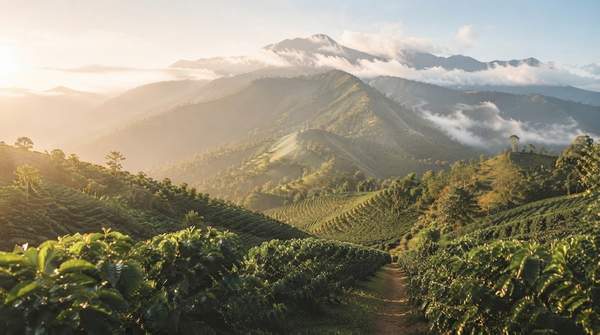
Terroir—the combined influence of local environment, animal diet, and human craft—explains why an artisanal cheese tastes like its home region and nowhere else. The concept, borrowed from winemaking, holds that a cheese's flavor and texture are not accidental: they are the measurable result of what the milk animals eat, the climate and materials of the place where the cheese matures, and the accumulated decisions of the people who make it. Three well-known cheeses illustrate the principle clearly: Parmigiano Reggiano, Appleby's Cheshire, and Old Roan Wensleydale each owe their recognizable character to a distinct combination of place and practice.
Terroir in Action: A Comparative Look at Artisanal Cheeses
Terroir is easiest to understand when it is broken into its working parts. The first component is the animal and its feed: milk is the raw material of cheese, and what the animal eats shapes that material. The second is the physical environment, especially the aging or maturation space, whose climate, materials, and character continue to act on the cheese long after the curd is formed. The third is human technique and tradition—the rules, timing, and hands-on knowledge that convert milk into a specific, named cheese rather than a generic one.
Consider how these components play out in practice. Writing for the cheesemonger Antonelli's, John Antonelli notes that Parmigiano Reggiano is produced in specific regions of Italy such as Parma and Reggio Emilia, where the cows are fed exclusively on local forage, which he credits with the cheese's rich, nutty, slightly fruity flavor. The same account describes how seasonal changes in pasture grass produce slight variations in the taste of Gruyère across the year—evidence that terroir is dynamic, not a fixed formula.
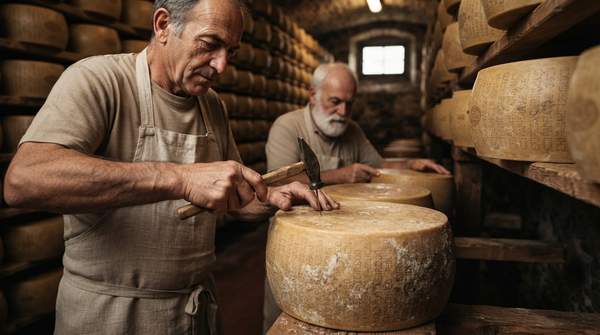
The protected designation rules for Parmigiano Reggiano make the place-based logic explicit. According to the dairy producer Ferrarini & Bonetti, the PDO regulations limit production to five provinces in Emilia-Romagna, require cows fed on local forages, mandate artisan processing within 24 hours of milking, and set a minimum aging of 12 months, with no additives or preservatives permitted. Each wheel uses roughly 550 liters of milk and averages 40 kilograms. In other words, the legal identity of the cheese is built directly on terroir's components: a defined zone, a defined feed, a defined method, and a defined maturation period.
The British examples show how the maturation environment itself becomes part of the flavor. The specialist retailer Rennet & Rind describes how Old Roan Wensleydale's lemony zing and its unusually moist, butter-like texture—stickier than the crumbly Wensleydales most people know—come in large part from its cloth-bound maturation period of three to four months, which retains more moisture than faster-made versions. The same account reports that the historic barns where Appleby's Cheshire matures "imbue the cheese with the essence of Cheshire's salt marshes," and that the traditional cellars used for Pitchfork Cheddar in Somerset foster depth and complexity. The character of an aging room—its climate, materials, and even its shape—is presented as a decisive factor in the finished cheese.
The comparison below maps these components side by side, so the reader can see exactly which elements of place and practice are credited with each cheese's character.
| Cheese | Animal & Feed | Environment & Aging | Human Technique & Tradition | Resulting Flavor/Texture Profile |
|---|---|---|---|---|
| Parmigiano Reggiano | Cows fed on local forages from the defined production zone | Production limited to five provinces in Emilia-Romagna; slow maturation with a minimum aging of 12 months | Artisan processing within 24 hours of milking; PDO rules prohibit additives or preservatives; roughly 550L of milk per 40kg wheel | Rich, nutty, slightly fruity flavor, attributed to the local forage |
| Appleby's Cheshire | Not detailed in the available accounts | Matures in historic barns, described as imbuing the cheese with the essence of Cheshire's salt marshes | Not detailed in the available accounts | Not described in the available accounts |
| Old Roan Wensleydale | Not detailed in the available accounts | Cloth-bound maturation of 3–4 months, retaining more moisture than quicker-made cheeses | Cloth-bound maturation as a deliberate traditional choice | Lemony zing; a moist, butter-like texture rather than the traditional crumble |
The gaps in the table are themselves instructive. Terroir is not a checklist in which every cheese documents every component; different cheeses are distinguished by different factors. For Parmigiano Reggiano, the feed and the codified method carry the identity. For the British cheeses, the maturation environment does the decisive work. Rennet & Rind also cautions that no two batches of cheese taste the same, framing that unpredictability as part of an artisanal cheese's one-of-a-kind character rather than a defect.
The Cheesemaker as Part of the Terroir
It is tempting to treat terroir as a purely environmental phenomenon—soil, grass, weather—but the human element is inseparable from it. The PDO framework makes this explicit: the five-province boundary, the 24-hour processing window, and the additive ban are human decisions, codified into law, that define what may bear the Parmigiano Reggiano name. Remove the tradition and the rules, and the same milk could become an entirely different cheese.
The same logic applies to smaller-scale makers. Choosing cloth-bound maturation over faster production is a craft decision that directly changes texture and moisture, as the Wensleydale example shows. Aging cheese in historic barns or traditional cellars, rather than in standardized facilities, is a choice to let a specific place keep acting on the cheese. In this sense, terroir is not passive influence but an active partnership: the environment supplies raw character, and the cheesemaker's experiential knowledge decides how that character is captured, shaped, and preserved. That is why the concept is often invoked in defense of artisanal practice itself—standardize the method, and you standardize away the place.
Identifying Terroir's Signature in Cheese
To fully appreciate an artisanal cheese, consider its terroir by examining the specific local environment, the animal's diet, and the traditional cheesemaking practices that define its unique characteristics. The practical test is simple: the ability to articulate specific terroir components (e.g., "pasture-fed cows", "cool, damp cellars", "traditional hand-pressing") when describing a cheese's flavor and texture. A reader who can explain that Parmigiano Reggiano's nuttiness is attributed to local forage within a five-province PDO zone, or that Old Roan Wensleydale's buttery texture comes from a three-to-four-month cloth-bound maturation, has moved from tasting a cheese to reading it—and knows exactly which questions to ask the next time a cheesemonger presents something unfamiliar.
Sources
- Taste of Place: How 'Terroir' Defines Our Food & Beverages — Antonellis Cheese
- What is Parmigiano Reggiano DOP? — Caseificio Ferrarini & Bonetti
- The Terroir of Cheese: Exploring the Influence of Farm Location — Rennet & Rind