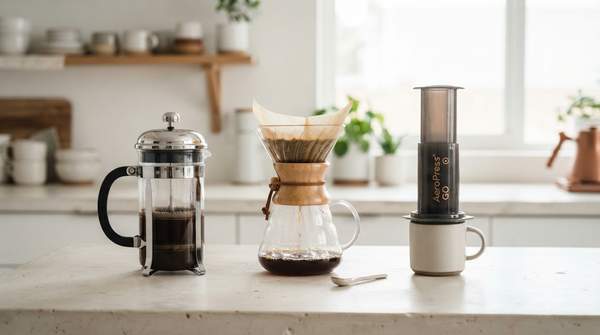
The short answer: choose the French press if you want a heavy, rich, full-bodied brew; choose pour-over if you prize clarity, brightness, and subtle nuance; and choose the AeroPress if you want a hybrid that can lean either way. The reason these three methods taste different comes down to two mechanical variables—how water meets the grounds (immersion versus percolation) and what stands between the brew and your cup (a metal mesh or a paper filter). Understanding those two variables is the whole game.
Understanding Coffee Extraction: Immersion vs. Percolation
Every brewing method can be sorted by how water contacts the coffee. Coffee By Design, a specialty roaster, draws the line clearly: immersion brewers "retain a given quantity of water in full contact with the coffee bed for a desired period of time before filtering," while drip methods "re-introduce fresh water to the grinds with every pulse or pour." In other words, immersion steeps; percolation flushes.
The second variable is the filter. A metal mesh lets oils and fine particles through into the cup; a paper filter traps them. That single difference drives much of the body-versus-clarity trade-off you taste across methods. Rock Creek Coffee Roasters adds that each method introduces its own variables—contact time, pressure, and filtration—all of which shape the final cup.
Keep these two axes in mind as you read the method profiles below: they explain why the same beans can taste like three different coffees depending on the brewer you reach for.
French Press: Full Body and Richness
The French press is the classic immersion brewer. Peet's Coffee describes it as offering "direct infusion for full extraction," calling it "an ideal companion for dark roasts, bringing out rich, complex flavors and luscious body." Because it uses a metal mesh screen rather than paper, oils and fine particles pass straight into your cup, which is where that heavy mouthfeel comes from.
Asser Christensen, writing at The Coffee Chronicler, offers a candid counterweight: the flavor profile "tends to be muddier and less nuanced compared to paper filtered coffees." He also flags a practical cost of the method—it is "difficult to clean compared to other coffee makers," and the mesh screen should be dismantled and washed with every use.
Latitude 23.5 Coffee & Tea frames the trade-off in terms of who it suits: the press is best for "coffee lovers who want full flavor and body" and for dark or medium-dark roasts, but "not ideal for" people who dislike sediment or heavy mouthfeel, or for "bright, acidic light roasts (they can taste muddled)." On price, their guide notes that around thirty dollars buys a genuinely great press that will last years, and most presses max out at three to four cups—though Christensen notes the biggest models hold around twelve cups (about 51 ounces).