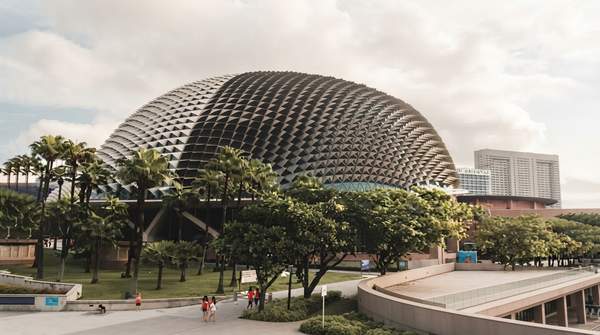
Biomimicry in architecture is not merely about making buildings that look natural. It is the practice of borrowing nature's functional strategies—its forms, its processes, its ways of solving problems—to address concrete design challenges such as material efficiency and energy consumption. The distinction matters: a leaf-shaped facade may be nature-inspired, but a cooling system modeled on termite mounds is biomimetic, because it emulates how nature works rather than how it looks. Understanding that difference gives readers a practical lens for evaluating any "nature-inspired" building they encounter.
What is Biomimicry? Emulating Nature's Genius
The academic literature draws careful boundaries around the term. A review of definitions published in the journal Biomimicry in Architecture distinguishes biomimicry from its near-neighbors. Where "biomimetics" refers broadly to technical translation of biological strategies, "biomimicry" specifically tends to be focused on developing sustainable solutions, as Cruz and colleagues frame it. "Bioinspiration," defined as a creative approach based on the observation of biological systems, likewise does not have to meet sustainability goals. In short: all biomimicry is bio-inspired, but only the strand aimed at sustainability earns the name biomimicry.
Practitioners make a parallel point about materials. Writing for Moss Architecture, Laura Cripe notes that biomimicry is about understanding how nature works, not simply using natural materials. A building can copy natural systems—passive ventilation, responsive shading—while being built entirely from modern materials. The imitation is functional, not compositional.
For analysis, this article uses a two-level framework drawn from that evidence: emulating form, where a building borrows a natural structure's shape or geometry, and mimicking process, where it borrows a natural mechanism for achieving a result. The two case studies below illustrate each level.
Case Study: Emulating Form – The Eiffel Tower's Femur-Inspired Strength
The Eiffel Tower is often cited as an early example of biomimicry at the level of form. According to the biomimicry education platform Learn Biomimimicry, Gustave Eiffel's Paris landmark, built for the Paris World Fair, was inspired by the human femur. The innovation lies in hierarchical construction and structural and material efficiency: the bone's internal architecture—dense where forces concentrate, hollow where they do not—demonstrates how to support enormous loads with minimal mass.
The tower's open lattice of wrought iron echoes that principle. The design problem was one every tall structure faces: achieving immense strength without prohibitive weight or material cost. By borrowing the femur's strategy of distributing load through an efficient internal geometry rather than through sheer bulk, the tower achieves robustness with remarkable economy of material. This is form-level biomimicry at its clearest: the borrowed element is a structural geometry, not a visible resemblance. Nothing about the tower looks like a bone; it behaves like one.
Case Study: Mimicking Process – The Eastgate Centre's Termite-Inspired Cooling
A more contemporary example operates at the level of process. The Eastgate Centre in Harare, Zimbabwe, designed by architect Mick Pearce, employs passive cooling techniques inspired by African termite mounds, which maintain stable internal temperatures despite wide external swings. The design problem was to keep a large commercial building comfortable in Harare's climate while minimizing reliance on conventional air conditioning.
The results were measurable. According to Pearce's architectural firm, as reported by Amusement Logic, "Eastgate uses 35% less total energy than the average consumption of six other conventional buildings with full HVAC in Harare." Dispensing with a conventional air-conditioning plant also saved roughly 10% of the total building cost. Notably, the reporting is candid that the motives guiding the design were, at the time, more practical and economic than ecological—energy savings and construction cost, not environmental virtue, drove the decision. The sustainability benefit followed from the economics.
That detail reinforces the framework: the Eastgate Centre did not copy a termite mound's appearance. It copied a process—using ventilation pathways and thermal mass to regulate temperature without mechanical cooling—and reaped quantifiable efficiency gains.
Biomimicry in Action: A Framework for Design Analysis
The table below classifies the two case studies by level of mimicry, natural model, design problem, architectural solution, and key benefit. Readers can apply the same columns to any nature-inspired building they encounter.
| Project | Level of Mimicry | Natural Model | Design Problem | Architectural Solution | Key Benefit |
|---|---|---|---|---|---|
| Eiffel Tower, Paris | Emulating form | Human femur | Achieving strength in a tall structure with minimal material | Hierarchical lattice structure that distributes weight efficiently | Structural and material efficiency |
| Eastgate Centre, Harare | Mimicking process | African termite mounds | Maintaining comfort in Harare's climate while reducing conventional air conditioning | Passive cooling techniques for environmental control | 35% less total energy than the average of six conventional HVAC buildings in Harare; ~10% construction cost savings |
The comparison is the analytical payoff. Form-level mimicry solves problems of structure and material; process-level mimicry solves problems of performance and operation. Both are functional, but they borrow different things from nature—one a geometry, the other a mechanism.
Beyond Aesthetics: The Functional Imperative of Biomimicry
The framework also serves as a filter against loose usage. A building that merely resembles a shell or a honeycomb without borrowing the structural logic behind it is nature-inspired design, not biomimicry. Moss Architecture's overview makes the same point from the practitioner's side: buildings may use designs based on termite mounds for natural cooling, honeycombs for lightweight structures, or tree systems for efficient support—strategies that improve comfort, performance, and sustainability. The value lies in the strategy, not the silhouette.
It is worth noting what this article does not claim. It is not a comprehensive catalog of biomimetic buildings, and it does not explore the detailed engineering or biological mechanics of the natural models. The systems level of biomimicry—designing whole buildings as ecosystems—is a real frontier, but the evidence here supports only the form and process levels, so those are the levels analyzed.
Evaluating Biomimetic Design: A Path to Sustainable Innovation
When evaluating nature-inspired designs, prioritize those that functionally emulate natural processes or systems for measurable benefits in sustainability and efficiency, rather than designs focused solely on aesthetic resemblance. The two case studies show why: the Eiffel Tower's femur-inspired lattice delivered material efficiency, while the Eastgate Centre's termite-inspired passive cooling delivered a documented 35% energy reduction against comparable Harare buildings.
A design's biomimetic success can be observed through its documented performance metrics—energy consumption, material efficiency—compared to conventional alternatives, and its explicit connection to a natural model's functional strategy. A building that claims nature's influence but offers neither a named natural strategy nor measured results is, at best, decoration.
Sources
- Biomimicry in Architecture: A Review of Definitions, Case Studies, and Design Methods - PMC
- What Is Biomimicry in Architecture? Buildings Inspired by Nature — Moss Architecture
- The Top 10 Real World Examples of Biomimicry in Architecture — Learnbiomimicry
- Efficient and eco-friendly design: Eastgate Center, Harare, Zimbabwe (+VIDEO) — Amusement Logic