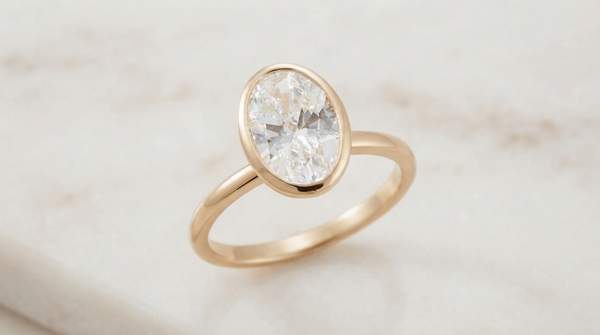
The single most important decision you'll make after selecting an oval diamond is where you sit on one trade-off: settings built to maximize sparkle, such as prong styles, expose more of the stone to light but leave it more vulnerable, while protective styles like the bezel trade some brilliance for security and a lower, snag-free profile. Jewelers' guidance is consistent on this point—the setting is the ring's architecture, and different settings offer varying levels of security, visual impact, and practicality. This guide compares the representative options so you can match the setting to your daily routine rather than choosing on looks alone.
The Core Trade-Off: Sparkle vs. Security
A diamond setting is the specific technique used to mount and secure the center stone, and as Brilliant Earth's styling guide puts it, the setting provides "the physical framework that holds the gemstone and supports the design." That framework directly influences three things that matter for a ring you'll wear every day: sparkle and light performance, stone security and durability, and comfort for everyday wear.
Jeffery Mayer, writing for Stienhardt, frames the practical question well: instead of asking only which diamond to choose, ask which type of setting best fits your lifestyle and daily routine. A setting is more than a structural feature—it defines the complete wearing experience. That means the choice isn't purely aesthetic. A ring that dazzles in a jewelry-store display case but sits high on your hand may not survive a gym routine, frequent handwashing, or work with your hands. Conversely, the most protective setting will never be the one that lets the most light into the stone.
No setting eliminates this tension entirely; each design philosophy accepts a compromise somewhere. Understanding which compromise you can live with is the whole decision.
Settings for Maximum Brilliance: Prong and Pavé
The prong setting—often called a "claw setting"—uses minimal metal to hold the diamond in place. That restraint is its entire purpose: with less metal blocking the stone, more light enters and exits, maximizing brilliance and light performance. The elevated profile of prong-set stones contributes to this effect, giving an oval diamond an open, luminous look that many buyers associate with the classic engagement ring silhouette.
The trade-off is vulnerability. Because prongs sit proud of the stone, they can snag on clothing and pockets, and a hard knock can bend a prong enough to loosen the stone over time. High-set prongs are more vulnerable than low-profile settings precisely because there is more exposed metal and more leverage against it. This doesn't make prongs fragile—millions of prong-set rings are worn daily without incident—but it does mean the style asks something of its wearer: attention during manual activities and a willingness to have the prongs inspected periodically so a loosened stone is caught before it's lost.
Pavé detailing, which studs the band with small diamonds, extends the same philosophy across the ring itself, adding surface sparkle around the center stone. It belongs firmly in the brilliance-first category: more glitter, more intricate surfaces to keep clean, and more small stones whose settings deserve occasional checks.
Settings for Enhanced Durability: Bezel
The bezel setting takes the opposite approach. A metal rim fully encircles the diamond, protecting the girdle—the stone's vulnerable edge—and holding it with continuous contact rather than a few contact points. A partial bezel covers only part of the outline, but the full bezel offers maximum protection. For an oval diamond, whose elongated silhouette exposes a longer girdle edge than a round stone, that continuous rim is a meaningful security advantage.
The cost is light. With less of the stone's surface exposed, a bezel offers medium sparkle compared with prong styles. What it gives back is a clean, minimalist aesthetic and a low, smooth profile that resists snags and knocks—an ideal match for active lifestyles, frequent travelers, and anyone who works with their hands.
For ovals specifically, the bezel has a distinctive visual benefit. According to the GIA, east-west settings—where the oval is set horizontally across the finger—work particularly well in minimalist or bezel-set designs, making even modestly sized diamonds appear larger and more distinctive on the hand. The elongated form reads as a considered style choice rather than a default orientation.
What About the Bow-Tie Effect?
One thing a setting cannot fix is the bow-tie effect—the shadowy area that runs across the center of most oval diamonds. It occurs because light moves differently through elongated shapes, and its visibility depends on cut quality, symmetry, and proportions, not on how the stone is mounted. If minimizing a bow-tie is a priority, evaluate the diamond itself under different lighting before buying; no prong, bezel, or halo choice will change it.
Oval Diamond Setting Decision Framework
The table below categorizes the representative setting styles across the same attributes, so the core trade-offs are visible at a glance. Use it to locate which category matches your priority before worrying about finer style details.
| Setting Style Category | Primary Goal | Visual Effect (Sparkle) | Stone Security | Best For (Lifestyle) |
|---|---|---|---|---|
| Prong (often called "claw") | Maximize brilliance and light performance | High—minimal metal lets more light enter and exit the stone | Medium—prongs can snag or bend, potentially loosening the stone; high-set prongs are more vulnerable than low profiles | Those who prioritize sparkle and stay mindful of the ring during daily activities; requires regular inspection |
| Bezel (full or partial) | Maximize stone security and durability | Medium—less exposed surface area, but the rim can make the stone appear larger and creates a clean, minimalist aesthetic | High—a full metal rim encircles and protects the girdle; partial bezels offer less coverage | Active lifestyles and low-maintenance wearers who accept somewhat reduced sparkle |
Read horizontally, the table shows the pattern: every gain on one attribute is paid for on another. The prong row buys its high sparkle with medium security and a maintenance commitment; the bezel row buys its high security with medium sparkle. No row dominates the other—which is why the right answer depends on you, not on the settings themselves.
Making Your Choice: Prioritizing for Your Lifestyle
Choose an oval diamond setting by prioritizing either maximum sparkle (e.g., prong settings) or maximum durability and security (e.g., bezel settings), based on your daily activities and maintenance willingness. If your days involve keyboards, commuting, and occasional dressy occasions, a prong setting's brilliance may be worth the periodic prong checks. If your hands meet gloves, weights, tools, or children on a regular basis, the bezel's protection and smooth profile will likely serve you better.
The measurable indicator of a good choice: the chosen setting visibly complements the oval diamond's shape and remains secure and comfortable during daily wear, with maintenance frequency aligning with your personal commitment. Judge candidates against that standard—try the ring on, note how it sits on your hand, and ask the jewer how often the setting should be inspected—before you commit.
Sources
- Brilliantearth
- Engagement Ring Settings Guide — MDT DESIGN
- The Best Settings for Oval Diamonds and Why They Work — GOODSTONE