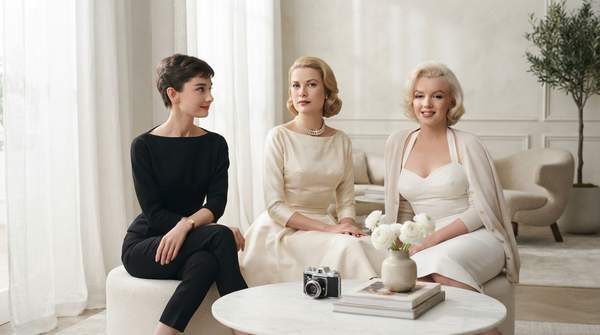
The style secrets of Old Hollywood are not really secrets at all—they are principles, applied with discipline. Audrey Hepburn built timeless elegance on simplicity, Grace Kelly on grooming and a signature accessory, and Marilyn Monroe on a confident, glamorous silhouette. Fashion commentary on the golden age of cinema describes their appeal as dressing "with poise and a pinch of mystery," grounded in a few signature pieces worn so consistently that they became "a personal autograph." Understanding how each woman applied those fundamentals—rather than copying any single outfit—is what lets a modern reader borrow the effect.
The Enduring Allure of Old Hollywood Style
What makes the stars of the 1940s and 1950s feel current in 2026 is not nostalgia but construction: clean lines, deliberate accessories, and an overall restraint that photographs well in any decade. The era's most-cited looks share a common grammar. Each hinges on one strong garment, one finishing accessory, and meticulous grooming. Fashion analysis of the period frequently ties this restraint to the standards of couture houses of the day—a sensibility fashion writers trace to designers such as Christian Dior, whose emphasis on good taste andsimplicity shaped what "elegance" meant on screen and off.
The practical payoff is that the formula survives trend cycles. As style coverage of the era notes, almost all of the signature pieces involved "can be found in today's stores." A reader does not need a vintage archive—only the ability to recognize the principle underneath each famous look.
Audrey Hepburn: The Epitome of Understated Chic
Hepburn's defining case study is the opening scene of Breakfast at Tiffany's (1961), where she wore a black Givenchy sheath with layered pearls and dark sunglasses—a look fashion commentary calls "the blueprint for evening chic." The genius of the ensemble is what it leaves out. There is no ornamental clutter, no competing color; the silhouette does the work, and her natural grace becomes the focal point.
That is simplicity as a strategy rather than an absence of effort. The pearls add a single point of interest, the sunglasses frame the face, and the rest is a masterclass in understatement. Translated into a modern principle: choose one clean, well-fitted garment as the canvas, add one deliberate accessory, and resist the urge to decorate further.
Grace Kelly: Sophistication Through Signature Accessories
Kelly's most enduring image is quieter but no less engineered: on the Riviera, she knotted a silk headscarf under her chin and paired it with oversized sunglasses. The combination projected refinement and a certain mystery—coverage of the era describes stars of her generation as dressing with exactly that "pinch of mystery." A second signature followed in 1956, when she shielded her pregnancy with an Hermès bag that was later renamed the Kelly in her honor.
The lesson is that a signature accessory, repeated until it reads as your own autograph, can define a personal style more powerfully than any single dress. For contemporary adaptation, the same coverage suggests copying the headscarf on windy fall days with a trench coat—a rare case where the original styling logic transfers almost unchanged.
Marilyn Monroe: Glamour and Confident Silhouettes
Monroe's iconic look runs in the opposite direction from Hepburn's minimalism, yet it obeys the same discipline. In The Seven Year Itch (1955), she stood over a subway grate in an ivory halter dress designed by William Travilla. The dress is a study in a single, confident line: a halter neckline that frames the shoulders and a flowing skirt built for movement.
Where Kelly's accessories added mystery, Monroe's styling added what era coverage calls "a provocative touch"—an interpretation that reads today as playful confidence. The principle to borrow is not the spectacle but the commitment to one strong, body-aware silhouette, carried with total conviction.
Old Hollywood Style Principles: A Comparative Framework
The table below deconstructs how three distinct personas applied a shared set of abstract principles—simplicity, grooming, and the signature accessory—to very different effects. The comparison demonstrates the flexibility of the fundamentals: same rules, three icons, three unmistakable aesthetics. Modern-application entries are interpretations of how each principle translates to a contemporary wardrobe, based on the iconic looks analyzed above.
| Style Icon | Core Principle | Signature Look Example | Modern Application |
|---|---|---|---|
| Audrey Hepburn | Simplicity: let one clean garment and one accessory carry the look, so natural grace is the focus. | Black Givenchy sheath with layered pearls and dark sunglasses, Breakfast at Tiffany's (1961). | A sleek black dress and a strand of pearls—described in era coverage as delivering "the same effect" today. |
| Grace Kelly | Grooming plus a repeated signature accessory, projecting sophistication and mystery. | Silk headscarf knotted under the chin with oversized sunglasses on the Riviera; the Hermès bag later renamed the Kelly (1956). | A silk scarf knotted under the chin with a trench coat on windy fall days; a well-chosen bag as a personal signature. |
| Marilyn Monroe | Confident, glamorous silhouette—one strong line, worn with conviction and a playful edge. | Ivory halter dress by William Travilla, The Seven Year Itch (1955). | A white halter dress or top, letting the silhouette and posture—not ornament—make the statement. |
Read across the rows, the model shows that timeless style is the application of principles, not the replication of a single outfit. One era-defining footnote: peep-toe shoes, which styling writer Linda Sheridan identifies as "a versatile and classic style" worn by most legendary Hollywood actresses, completed Kelly's sophisticated looks and added a contrasting provocative touch to Monroe's ensembles—a shared period piece that could finish any of the three approaches.
Applying Timeless Principles to Your Modern Wardrobe
Turning the framework into practice requires only a few decisions. Pick your anchor principle first: if Hepburn's understated chic resonates, build around a simple, well-cut black dress and keep jewelry to a single strand of pearls. If Kelly's polish is closer to your aesthetic, invest in one signature accessory—a knotted silk scarf, oversized sunglasses, or a structured bag—and wear it consistently until it reads as your own. If Monroe's confidence is the draw, choose one halter silhouette that moves, and let fit and posture do the rest.
Keep in mind the limits of this kind of analysis: it rests on a handful of iconic looks, not the full range of any actress's wardrobe, and the principles reflect fashion commentary rather than direct statements by the women themselves. The wardrobe suggestions are interpretations of historical styling, not rules the actresses set.
Embrace Your Inner Icon: A Path to Timeless Style
Readers should identify which icon's approach to simplicity, grooming, and signature accessories resonates most with their personal aesthetic and begin incorporating those principles into their contemporary wardrobe. The starting point is small and testable: pick the element that fits your eye—Hepburn's pared-back sheath and pearls, Kelly's knotted scarf and sunglasses, or Monroe's halter silhouette—and wear it as the anchor of one everyday outfit rather than saving it for an occasion. The measure of success is concrete: the reader successfully identifies a signature element from an icon and integrates it into their daily style, leading to increased confidence and a more cohesive personal look. If, after a week of wear, the piece feels like an autograph rather than a costume, the principle is working.
Sources
- Forget Fleeting Fashion Trends — Grazia USA