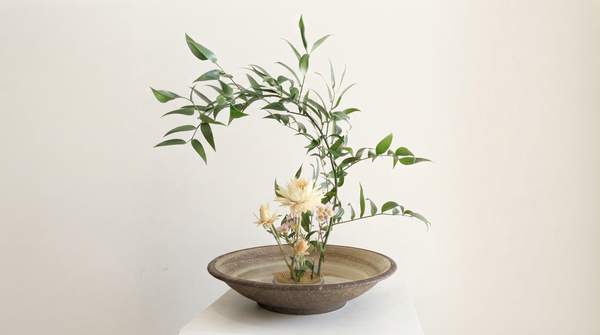
Ikebana, the Japanese art of flower arrangement, offers minimalist interiors something a full bouquet cannot: a sculptural focal point built from line, space, and restraint. Its core principles—simplicity (Kanso), negative space (Ma), and asymmetry—translate directly into decisions about what to cut, how to arrange it, and where to place it in a room. This article converts those principles into a practical framework for creating and siting an Ikebana-inspired arrangement in a modern home.
Ikebana: A Philosophy for Modern Minimalist Interiors
Ikebana, also known as kadō or the "way of flowers," is a centuries-old Japanese practice that, as the Japanese Friendship Garden of Phoenix describes it, "transcends the mere placement of flowers," weaving together tradition, philosophy, and artistic expression. Its relevance to contemporary interiors is not incidental. Wazakura Japan, a Japanese craft retailer writing on home decor lessons from Ikebana, notes that Kanso—a Zen principle of simplicity or purity—"emphasizes minimalism in design and living, aligning with modern minimalist architecture and home decor."
The same source points to the traditional Japanese interior as a model: a single Ikebana arrangement or a calligraphy scroll displayed in a tokonoma, the alcove of a Japanese room, highlighting "the beauty of simplicity and essentialism." That is essentially the minimalist display logic—few objects, deliberately placed—already at work. Ikebana also brings seasonal awareness indoors; Wazakura Japan describes arrangements as "a snapshot or portrait paying reverence to the season," turning floral design into living sculpture that conveys nature's impermanence.
Core Principles: Simplicity, Negative Space, and Asymmetry
Three principles carry most of the practical weight. Simplicity (Kanso) conveys beauty by using only the most essential forms and avoiding unnecessary ornamentation, in the Japanese Friendship Garden's summary of the art's guiding pillars. Practically, this means a few focal elements arranged with precision rather than a dense bouquet.
Negative space (Ma) is the intentional void. The Japanese Friendship Garden identifies "Silence" as one of Ikebana's seven principles, built on the concept of ma, while Viola Floral, writing on Ikebana-inspired arranging, observes that "the intentional void between two flowers and branches can evoke more feeling than an overflowing bouquet." Emptiness is not absence; it is a compositional element.
Asymmetry reflects nature's balance rather than geometric perfection. Nordic Nest's beginner guide notes that Ikebana compositions "often appear slightly off-centre, creating a dynamic and natural look," with balance typically struck among three main elements—often symbolizing heaven, earth, and humanity—represented by stems of different heights in a loose triangular structure.