Designing a Zen-inspired garden is less about copying a look and more about applying a small set of philosophical principles to concrete choices: which rocks to select, how much space to leave empty, and how to arrange what remains. Zen gardens—known in Japan as karesansui, or dry landscape gardens—originated in temple settings as spaces for contemplation and meditation, using carefully arranged natural elements to symbolize mountains, rivers, islands, and the flow of nature rather than colorful flower displays. This article translates four core principles—simplicity, asymmetry, naturalness, and symbolism—into a practical decision framework a modern homeowner can actually use.
Understanding the Essence of Zen Gardens
What surprises many first-time designers is that a Zen garden's minimalism is not an aesthetic shortcut but a deliberate philosophical stance. Writers on Japanese garden design consistently describe these spaces as embodying simplicity, balance, and mindfulness—environments intended to slow the visitor down and invite reflection. Scenic Landscaping, a landscape design firm, identifies the core principles as simplicity and restraint, balance and asymmetry, natural materials, open space and minimalism, and harmony between architecture and landscape. Crucially, every stone, pathway, tree, and planting is intentionally placed; the goal is not to fill the space but to create an environment that feels peaceful, balanced, and timeless. That intent, not the specific materials, is what a modern adaptation needs to preserve.
The Symbolic Language of Elements: Rocks, Gravel, and Plants
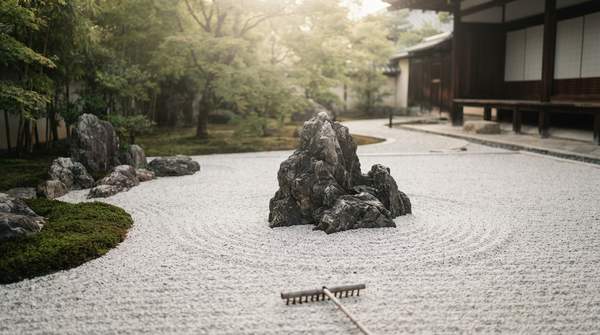
The physical vocabulary of a Zen garden is deliberately small, and each element carries symbolic weight. Rocks and stones typically stand for mountains or islands within a miniature landscape. Gravel and sand, raked in curving and circular formations, represent water—an account echoed across the sources as the central symbolic gesture of the dry garden. The raking itself is a technique: small rakes drag along the sand or gravel to create patterns that evoke ripples and flow. Plants play a supporting role, kept minimal so that the garden reads as a stylized, not literal, representation of nature. The evidence available here does not assign specific symbolic meanings to individual plant species, so treat greenery as a general evocation of the natural world rather than a coded message.