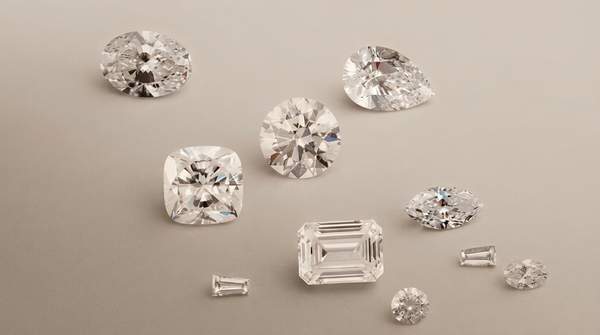
When a gemstone catches your eye, what you are seeing is not an accident of nature but a series of deliberate design decisions. Two broad cutting philosophies—brilliant-style cuts and step-style cuts—pursue different optical goals: one scatters light to maximize sparkle, the other organizes light to showcase a stone's color and clarity. Understanding which philosophy a stone represents lets you predict its appearance before you ever see it in person.
Understanding Gemstone Sparkle: Brilliance and Scintillation Defined
The two words most often conflated in jewelry descriptions are actually distinct optical properties. Award-winning gem cutter John Dyer defines brilliance as how bright a gem looks "when both the gem and the viewer are stationary." This perceived brightness, he explains, depends on two things: the amount of light reflected back to the eye, and the contrast pattern created by the cut. Counterintuitively, a gem with strong contrast between light and dark reflections appears brighter than one reflecting the same amount of light in a more uniform wash.
Dyer illustrates the contrast effect with a simple demonstration: viewers almost universally rate a circle with broken-up black and white regions as brighter than one with the same 50/50 ratio distributed in large blocks. The total light is identical; only the distribution differs. This is why facet layout matters as much as raw light return.
Scintillation, by contrast, is dynamic. It is the pattern of flashes—of light and of dark—that plays across the stone as the gem, the light source, or the viewer moves. When people describe a gem as "sparkly" or "lively," Dyer notes, they are usually describing a combination of stationary brilliance and this moving scintillation. The distinction matters for buyers: a stone can be bright when still yet lifeless in motion, or vice versa. Neither property is automatically superior; each answers a different aesthetic preference.
Brilliant Cuts: Maximizing Light Return and Sparkle
Brilliant-style cuts pursue sparkle as their primary objective. Their design philosophy, as John Dyer Gems and the Natural Gemstone Company both describe, centers on arranging facets—generally many small, triangular and kite-shaped faces—at angles calculated to bounce light back out through the crown rather than letting it leak away through the bottom. The result is maximum reflected light, distributed into a high-contrast pattern of bright flashes separated by dark reflections.
The consequence of that geometry is predictable: brilliant cuts deliver strong brilliance and active scintillation in a single stone. The many separate facets create many small reflective regions, which—by the contrast principle above—read to the eye as intense brightness, and which produce rapid flashing as the stone tilts. This is why the round brilliant remains the default for diamonds, where the goal is light performance rather than body color.
Two qualifications temper the promise. First, cut design and cut quality are separate variables: a poorly executed brilliant cut fails to deliver its intended light return regardless of its blueprint. Second, effectiveness depends on the gem material itself—its refractive index governs how much light the stone can bend and return. And within well-cut stones, Dyer notes, the final choice between designs is often simply personal taste.
Gemstone Cut Design: Brilliance vs. Color/Clarity
The table below classifies the two major cut families by their design intent, so you can read a stone's style and anticipate how it will behave in light. It also flags the trade-off each family accepts.
| Dimension | Brilliant-Style Cuts | Step-Style Cuts |
|---|---|---|
| Design Philosophy | Maximize light return and sparkle | Showcase the stone's inherent color, clarity, and internal character |
| Facet Style | Many small triangular and kite-shaped facets at angles engineered to reflect light back to the eye | Larger, parallel facets arranged in steps, creating broad reflective planes |
| Primary Optical Effect | High brilliance (stationary brightness) plus scintillation (moving flashes) | Emphasis on color depth and clarity display; less sparkle than brilliant cuts, but a different, quieter visual appeal |
| Best For | Stones and buyers whose priority is maximum brightness and lively motion | Transparent stones with excellent color and clarity worth displaying prominently |
| Key Trade-off | Some scintillation may be sacrificed to protect other qualities, and results depend on cut quality and the gem's refractive index | Larger, open facets make inclusions more visible |
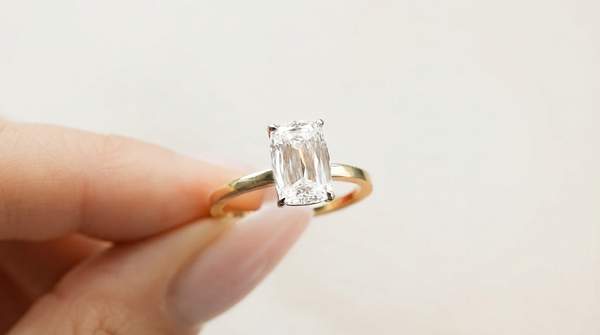
Read one way, the table shows that neither family is "better"—they are different answers to the question of what a stone should do with light. Brilliant cuts scatter it into sparkle; step cuts organize it into a window onto the material itself, in the manner of an emerald cut's hall-of-mirrors planes.
The Gem Cutter's Dilemma: Balancing Beauty and Material
A gem's cut is never arbitrary; it is negotiated with the raw stone. Minerals Paradise identifies the principle that governs colored-stone cutting: light path length determines color saturation. The longer light travels through colored material before returning to your eye, the more color it absorbs and the deeper the stone appears. Cutters exploit this deliberately—a richly saturated, dark stone such as a strong blue tourmaline is cut shallow, with a low crown and flat pavilion, to keep the color from going black, while pale material is cut deeper to intensify its color.
Inclusions drive decisions in the opposite direction. The Natural Gemstone Company notes that classic cuts follow guidelines designed to maximize brilliance, but stones with unique color patterns or flaws sometimes demand custom designs that make the stone's innate character the centerpiece. A strategic cut can also improve apparent clarity by masking inclusions, which is generally desirable—though step cuts, with their large open facets, offer no such camouflage and put any internal feature on display.
Even within the sparkle category, trade-offs persist. Dyer describes cutting styles that gain resistance to "tilt windowing"—the dark or washed-out area that appears when a stone is viewed off-angle—at the cost of some scintillation. Every cutter's decision about depth, crown height, table size, and facet angles balances light performance against the material's color, clarity, and shape, and the exact balance depends on the individual stone and the cutter's skill.
Choosing Your Sparkle: Matching Cut to Preference
Because "sparkle" itself is a composite—Dyer observes that most people mean some blend of brilliance, scintillation, dispersion, and tilt performance—identifying which factor matters most to you is the practical first step in choosing a stone. If flash and liveliness are the goal, brilliant-style cuts deliver them by design. If the goal is a stone's color or crystal-clear purity, step cuts present those qualities without the visual noise of constant sparkle.
Then evaluate stones against that priority directly. Ask to view the gem under different lighting conditions and in motion: a brilliant cut should show strong stationary brightness with a crisp light-dark contrast pattern, and should flash actively as it tilts. A step cut should hold a clean, even color across its broad facets, with clarity visible through the open planes—check for inclusions you can live with, since the geometry will not hide them.
Making Your Choice: Sparkle, Color, or Both?
When selecting a gemstone, choose a brilliant-style cut if your priority is maximum sparkle and brightness, or a step-style cut if you wish to emphasize the stone's inherent color and clarity. Neither choice is a compromise; each is an honest match between design intent and material.
To verify your choice before committing, observe the gemstone's light performance under different lighting conditions and movements: confirm that it exhibits the balance of brilliance and scintillation you want, or that its color and clarity are displayed as prominently as you expected. A stone that performs the way you prioritized in the store will keep performing the same way on your hand.
Sources
- What Gemstone Cut Is the Best and Sparkles Most? — Johndyergems
- Introduction to Gemstone Cuts - The Natural Gemstones Company | The Natural Gemstone Company
- Gemstone Cuts Explained: Every Shape, Color and Brilliance Guide — Minerals Paradise
- Gemstone Cuts and Optics - The Natural Gemstones Company | The Natural Gemstone Company