Post-war haute couture was defined by a dramatic return to opulence, and no single moment captures that reversal better than Christian Dior's "New Look" of 1947. Yet the story of how fashion moved from structured post-war femininity to the liberated aesthetics of the late 1960s and early 1970s requires more than one designer. Pierre Balmain's "Jolie Madame" offered a parallel vision of 1950s elegance, while Yves Saint Laurent's "Scandal" collection of 1971 broke from couture's pristine elegance and pointed toward modern ready-to-wear. Together, these three styles trace a clear arc: from luxury as a response to austerity, to provocation as a design philosophy.
The Dawn of Post-War Opulence: Dior's "New Look"
Christian Dior founded his namesake house on December 16, 1946, at 30 Avenue Montaigne in Paris, backed by the industrialist Marcel Boussac, with three ateliers and a staff of 85 people, as fashion historian accounts of the house record. His first collection, shown on February 12, 1947, introduced the famous "New Look" alongside his first perfume, Miss Dior, named after his sister Catherine. That debut remains one of the most discussed openings in fashion history.
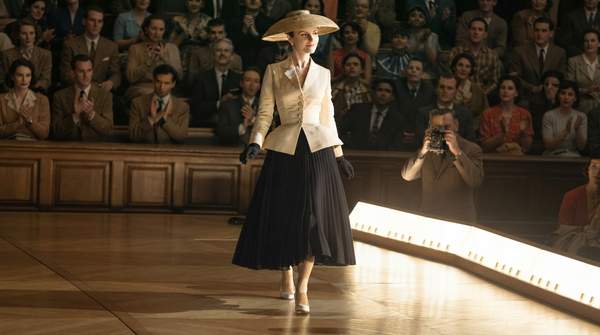
The silhouette itself was the revolution. According to Sotheby's guide to haute couture, the New Look was "characterised by narrow waists and voluminous skirts, breaking from the straight lines of the previous decades." The rounded shoulders, cinched waist and full, calf-length skirt reintroduced opulence and femininity after years of wartime rationing and utilitarian dress. Vogue College of Fashion's overview of major houses describes Dior's work as defined by opulent designs and an emphasis on femininity, qualities that made the house a lasting symbol of luxury and elegance.
What made the collection consequential was its timing. Emerging after the austerity of World War II, the New Look answered a widespread desire for luxury and marked a dramatic departure from the practical, fabric-conserving styles that had dominated the war years. Its influence, as Sotheby's notes, went on to "pervasively influence the industry," defining the silhouette of the late 1940s and 1950s.
Balmain's "Jolie Madame": A Parallel Vision of Elegance
Dior was not alone in rejecting wartime austerity. Pierre Balmain's "Jolie Madame," which emerged in the 1950s, offered a competing but equally opulent interpretation of post-war femininity. The style was destined, as one fashion history account puts it, for "post-war Parisian women who started emancipating themselves in the 50s, and could show their power through the innovative Balmain's designs."
The aesthetic was unmistakably luxurious. "Jolie Madame" favored noble materials and an opulent, elegant look, built on a structured silhouette with marked shoulders, an underlined chest and a cinched waist. It appeared most often on evening gowns, and its signature elements recurred throughout Balmain's collections, becoming symbols of a new femininity. The style contrasted deliberately with the utilitarian fashion of the 1940s.
Its cultural standing was sealed by an unexpected authority: the writer Gertrude Stein, writing in Vogue magazine, defined it as "the New French Style." Where Dior's New Look became the international shorthand for post-war fashion, Balmain's Jolie Madame became its Parisian counterpart — equally structured, equally feminine, but framed around a client who wanted her clothes to project power and emancipation. WWD's retrospective look at the style, illustrated with photographs of figures such as Katharine Hepburn and Josephine Baker in Balmain gowns, underscores how closely the house was tied to prominent women of the era.
Shifting Tides: Yves Saint Laurent's "Scandal" Collection
By the late 1960s, the consensus behind couture's structured elegance was fracturing, and Yves Saint Laurent was the designer pushing it apart. His motivations were partly practical: as one account of his career explains, he "was willing to provide a stylish ready-to-wear alternative for those who couldn't afford his expensive haute couture clothes." That impulse — to design outside the couture system rather than within it — was itself a break from the Dior and Balmain model.
The rupture became explicit with the collection known as "Libération," remembered as the "Scandal" collection because its designs evoked Paris during the Occupation in the Second World War. The press severely criticized it. Yet the same account argues that one has to recognize it "set the tone for a new kind of prêt-à-porter, thus liberating fashion from the pristine elegance and strict couture seen at the time to leave room for modern aesthetics."
The irony is sharp: a collection that looked backward to wartime Paris became the vehicle for fashion's forward movement. Where Dior had answered the Occupation years with volume and luxury, Saint Laurent answered the polished couture decades with provocation — and with a ready-to-wear framework that made high design accessible beyond the couture client. His earlier transparent dress "La Cigaline" from 1968 belongs to the same trajectory of challenging convention.
Comparing Iconic Post-War Haute Couture Styles
Placing the three styles side by side reveals the evolution from post-war opulence to the beginnings of modern ready-to-wear. Each row below reflects what the historical record supports about the collection's date, silhouette, context and legacy.
| Designer & Collection/Style | Era | Key Silhouette Features | Socio-Cultural Context | Legacy |
|---|---|---|---|---|
| Christian Dior's "New Look" | Debuted February 12, 1947; defined the late 1940s and 1950s | Narrow, cinched waist; voluminous, full skirt; rounded shoulders; departure from the straight lines of previous decades | Response to wartime austerity and a desire for luxury after World War II | Pervasively influenced the industry; made Dior a symbol of luxury and elegance |
| Pierre Balmain's "Jolie Madame" | Emerged in the 1950s | Structured silhouette with marked shoulders, underlined chest and cinched waist; luxurious, noble materials; seen mostly on evening gowns | Dressed post-war Parisian women expressing emancipation and power; contrasted with 1940s utilitarianism | Named "the New French Style" by Gertrude Stein in Vogue; signature elements of Balmain's collections |
| Yves Saint Laurent's "Scandal" collection | Debuted in 1971 | Designs evoking Paris during the WWII Occupation | A ready-to-wear alternative for those who couldn't afford haute couture; a break from strict couture elegance | Severely criticized by the press, but credited with setting the tone for a new kind of prêt-à-porter and modern aesthetics |
Read across the rows, the table shows a shift in both silhouette and purpose: from the New Look's engineered volume, to Jolie Madame's equally structured but power-oriented elegance, to Scandal's deliberately provocative ready-to-wear. The client changes too — from the post-war woman craving luxury, to the emancipating Parisian, to the customer outside the couture salon altogether.
Charting Fashion's Future: From Structured Elegance to Modern Sensibility
Recognize that post-war haute couture, while initially defined by a return to opulence and structured femininity, progressively evolved towards more liberated and provocative styles, laying the groundwork for modern fashion. Dior and Balmain built their reputations on construction and luxury as a response to hardship; Saint Laurent built his on challenging what those constructions had come to represent.
The measurable indicator of this evolution is the shift in silhouette and construction from the late 1940s to the early 1970s, visible in the historical collections and their critical reception: the cinched waist and voluminous skirt of 1947, the marked shoulders and structured evening gowns of the 1950s, and the press-condemned, Occupation-evoking ready-to-wear of 1971. For the reader tracing fashion's course, the next question is how far that liberation extended — and the Scandal collection's hostile reception, followed by its credited role in establishing modern prêt-à-porter, is the clearest evidence that the shift was contested every step of the way.